Built From the Ground Up in Cedar
The Jocisland greenhouse is built with a premium cedar frame reinforced with metal hardware for long-term durability. That pairing — natural wood and reinforced hardware — matters more than it might seem at first glance.
Cedar is one of the most time-tested materials in outdoor construction, and for good reason. Its natural oils resist moisture, decay, and insect damage without the need for chemical treatment. Unlike pressure-treated lumber or painted pine, cedar weathers gracefully. It grays out over time in an attractive, dignified way, or you can apply a stain to preserve its warm honey tones. Either way, it sits in a garden without looking industrial or temporary.
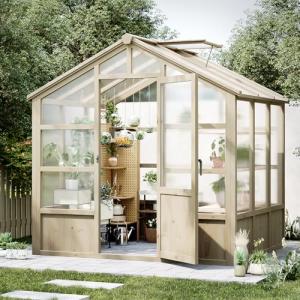
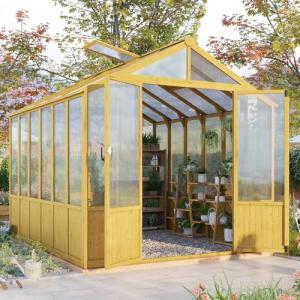
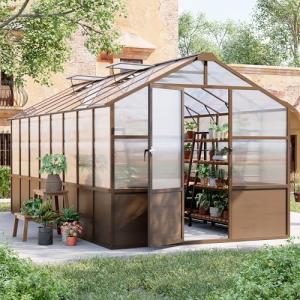
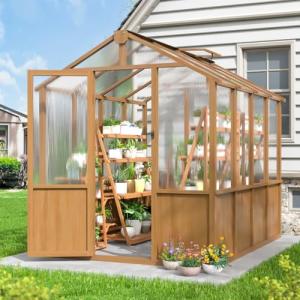
Walking into the Jocisland greenhouse, the solid feel of the cedar frame is immediately noticeable. The warm, natural wood gives it a sturdy, inviting presence that plastics and aluminum simply can't match.
The reinforced metal hardware throughout the frame is what keeps the cedar honest under load. Bolted connections at the joints mean this structure doesn't rely on wood screws alone — it's mechanically fastened in a way that holds up to seasonal stress, wind pressure, and the general chaos of weather.
The wind rating reaches 24–38 mph, and the maximum load capacity is 440 lbs, ensuring stability across a range of weather conditions. For a backyard greenhouse in most of North America, that's a performance envelope that covers the vast majority of seasonal conditions short of a true storm event.
Dimensions That Actually Work for Humans
The dimensions of a walk-in greenhouse are where the gap between a product spec and real-world usability becomes very clear. A structure marketed as "walk-in" that gives you five feet of headroom isn't walk-in — it's crouch-in.
With a wall height of 4.86 feet and a 6.46-foot peak height, this greenhouse provides ample space to move around — ideal for gardening, relaxation, and more. Once inside, the spacious interior is a genuine pleasant surprise, with room for multiple shelves and plants.
At six feet wide and eight feet deep, the 48 square feet of interior floor space is enough to run two planting benches along the side walls with a clear working aisle down the middle. That's more than sufficient for a serious home grower to start hundreds of seedlings, overwinter container plants, grow herbs through December, or maintain a year-round salad garden of lettuces and greens.
For reference, a standard potting bench runs about 24 inches deep. Two of them fit comfortably against the long walls, leaving you roughly two feet of central aisle — enough to turn around in, kneel down in, and work without constantly bumping into things.
The Pre-Assembled Design: What It Actually Means
Most greenhouse kits in this category come as a pile of pieces with an intimidating hardware bag and a manual written for someone with an engineering degree. The Jocisland takes a different approach.
The assembly process is surprisingly straightforward. Pre-assembled walls, doors, and windows mean you only need to connect the pieces with the included hardware. Setup takes less than two hours even for a beginner — the design feels thoughtful, making it accessible without sacrificing durability.
The pre-assembled panels are the key distinction here. Rather than constructing the frame stick by stick and then fitting panels into it, the major sections — walls, door unit, window units — arrive as complete assemblies. Your job on installation day is to connect those assemblies to each other, not build them from scratch. That's a fundamentally different task, and it's what makes the difference between a day-long project and a weekend-consuming ordeal.
For gardeners who aren't particularly handy, this matters enormously. And for those who are experienced, it's simply a better use of time.
Polycarbonate Panels: The Science of Smart Glazing
The choice of glazing material is arguably the most consequential decision in greenhouse design, and the Jocisland makes a good one.
The high-quality twin-wall polycarbonate (sunboard) panels offer heat insulation and UV protection, maintaining a comfortable interior temperature while protecting plants from harmful rays.
Twin-wall polycarbonate — sometimes called "twinwall" or "multiwall" poly — is the professional grower's preferred glazing for good reasons. It's structured with two layers of polycarbonate separated by vertical channels, creating a thermal air gap that dramatically improves insulation versus single-pane glass or single-layer poly sheeting. This means the heat you build up during a sunny afternoon lingers longer into the evening, and the cold outside is slower to penetrate in.
The UV-blocking properties are equally important. Full, unfiltered UV radiation stresses plants and can cause leaf scorch, bleaching, and cellular damage. Twin-wall polycarbonate diffuses incoming light rather than transmitting it in hard direct beams, which actually produces more even plant growth — no single hot spot, no shadowed corners.
It's also essentially unbreakable under normal circumstances. Polycarbonate is impact-resistant in a way glass never is, which matters if you share your backyard with children, tools, or the occasional windblown branch.
Ventilation: The Detail That Separates Good Greenhouses from Great Ones
Temperature management is where many budget greenhouses fail completely. A sealed structure in full sun can hit 120°F or higher within an hour on a warm spring day — conditions that will cook seedlings rather than grow them. Ventilation isn't a convenience feature; it's a core functional requirement.
The Jocisland addresses this with adjustable roof vents and a lockable door that together allow easy control of temperature and humidity, ensuring optimal airflow and healthy plant growth.
The adjustable roof vents are positioned at the peak of the structure, which is the correct placement thermodynamically. Hot air rises and accumulates at the top of an enclosed space. Venting from the peak allows that accumulated heat to escape directly, pulling cooler air in from lower openings as it does. It's passive convection at work — no electricity, no fans, just intelligent placement.
The lockable door adds an important layer of security and functionality. In cooler weather, a locked, sealed door helps retain heat overnight. In summer, propping it open becomes your primary ventilation strategy. The lockable mechanism also means this structure can serve double duty as secure storage for tools, soil, fertilizers, and other garden supplies you don't want disappearing from an open shed.
Year-Round Utility: More Than Just a Growing Season Extender
The most compelling argument for a quality cedar greenhouse over a budget alternative isn't what it does in spring. It's what it does in November, January, and February.
A properly glazed and ventilated greenhouse in most temperate zones will maintain daytime temperatures 20–30°F above ambient outdoor temperature simply through the passive solar gain of its polycarbonate panels. On a 35°F winter day with full sun, the interior temperature can comfortably reach 55–65°F — warm enough for overwintering citrus trees, growing cold-hardy greens, or keeping dormant container plants alive through the worst of winter.
The cedar frame handles freeze-thaw cycles without warping, cracking, or corroding the way aluminum or PVC frames eventually do. Cedar's cellular structure absorbs and releases moisture slowly, resisting the dimensional changes that cause joints to loosen and panels to gap over time. This is a structure designed for permanence, not convenience.
For gardeners who grow tender perennials — figs, bougainvillea, olive trees, dahlias, cannas — a cedar greenhouse becomes an essential winter holding space that turns expensive plants from annual purchases into multi-decade investments.
Comparison: Jocisland vs. Competing 6×8 Greenhouse Options
| Feature | Jocisland 6×8×6.5 | Aluminum Frame 6×8 | PVC Hoop 6×8 | Budget Polycarbonate Kit 6×8 |
|---|---|---|---|---|
| Frame Material | Solid Cedar | Powder-coated aluminum | PVC pipe | Thin aluminum |
| Peak Height | 6.46 ft | ~6.5 ft | ~6 ft | ~6 ft |
| Wall Height | 4.86 ft | ~4.5 ft | ~4 ft | ~4 ft |
| Glazing | Twin-wall polycarbonate | Single/double poly | Poly film cover | Single-layer polycarbonate |
| Assembly | Pre-assembled panels | Piece-by-piece | Pole + cover system | Piece-by-piece |
| Wind Rating | 24–38 mph | ~30 mph | ~20 mph | ~25 mph |
| Max Load | 440 lbs | ~300 lbs | ~150 lbs | ~200 lbs |
| Ventilation | Adjustable roof vents + lockable door | Fixed or adjustable vents | Roll-up sides | 1–2 roof vents |
| Aesthetics | Natural wood, garden-grade | Industrial look | Temporary/utilitarian | Plastic appearance |
| Longevity | 10–20+ years with maintenance | 10–15 years | 3–5 years | 5–8 years |
| Security | Lockable door | Varies | No lock | Varies |
| Best For | Serious home growers, year-round use | Mid-range year-round | Seasonal/temporary use | Budget season extension |
Who This Greenhouse Is Built For
The Jocisland 6×8×6.5 is not a greenhouse for the casual gardener who wants to get an extra few weeks out of summer herbs. That person will be perfectly served by something cheaper and less permanent.
This is a greenhouse for the gardener who has graduated past that phase. The person who starts hundreds of seedlings each March, overwinters at least a few tender specimens, wants a dedicated propagation space, or simply believes that a garden tool should be built to the same standard as the garden itself. It's for someone who looks at their backyard as a long-term project and understands that the right structure, bought once, is worth far more than the wrong structure replaced every few years.
Cedar is more stable than traditional aluminum frame greenhouses, and the natural material blends seamlessly into a backyard setting, giving off a timeless charm that holds up well against wind.
It's also for the gardener who cares how their backyard looks. Cedar doesn't look like a piece of industrial equipment dropped in a garden. It looks like it belongs there — like something that was chosen rather than defaulted to.
Final Verdict
The Jocisland 6×8×6.5 Ft Wooden Greenhouse earns its place as one of the stronger options in the pre-assembled cedar greenhouse market by doing the fundamentals right: quality frame material, smart glazing, intelligent ventilation design, and an assembly approach that actually respects the buyer's time. Its combination of a solid cedar frame, reinforced metal hardware, twin-wall polycarbonate panels, and a 440-lb load capacity with a 24–38 mph wind rating puts it in a different performance category than the budget aluminum-and-single-poly kits that crowd the lower end of the market.
If you're ready to stop fighting the seasons and start working with them, this is a structure worth investing in.