First Impressions: A Greenhouse That Looks Like It Belongs
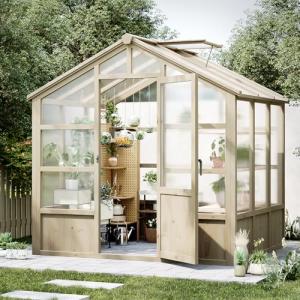
Walk into most backyards with a budget greenhouse standing in the corner, and it looks like an afterthought — a utilitarian eyesore draped in milky plastic sheeting. The AirWire is a different proposition from the moment you lay eyes on it.
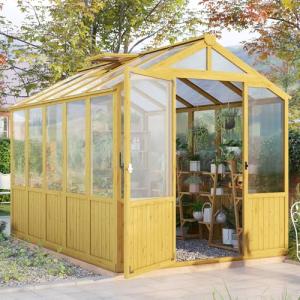
The warm brown cedar frame gives the structure an architectural coherence that metal alternatives simply can't replicate. Cedar has been used in outdoor construction for centuries precisely because it ages gracefully — developing a silvery patina over time that complements garden settings rather than fighting them. This isn't decorative wood cladding over a steel skeleton; the cedar is structural, contributing genuine rigidity and thermal mass to the build.
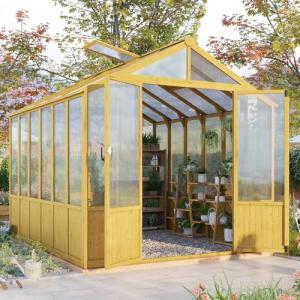
At 8 feet wide and 16 feet long, this is a genuinely substantial structure. The footprint — 128 square feet of growing space — is large enough to accommodate dedicated planting beds, raised staging shelves, a potting station, and still leave room to move comfortably between rows. For context, that's enough floor area to grow full-sized tomato plants along both interior walls simultaneously while maintaining a clear central walkway.
The Frame: Cedar Meets Aluminium Alloy
The AirWire greenhouse is constructed using high-quality solid pine timber and premium hardware, reinforced with an aluminium alloy frame — though the cedar-frame variant takes this structural philosophy even further. Cedar timber is firmer and less vulnerable to moisture than many alternatives, which matters enormously in an outdoor structure exposed to rain, humidity, and ground-level dampness year-round.
This hybrid construction approach is one of the most thoughtful design decisions in the AirWire's build. Pure wood greenhouses, while beautiful, can warp and swell with seasonal moisture changes. Pure metal frames conduct cold efficiently — meaning your structure can become a radiator of frost in winter rather than a barrier against it. By combining cedar's thermal and aesthetic qualities with aluminium's dimensional stability, AirWire gets the best of both materials where each counts most.
Wood heated by the sun during the day retains that warmth and releases it slowly overnight — a passive heating benefit that metal frames cannot provide. In early spring and late autumn, this thermal mass effect can mean the difference between a frost-damaged crop and a thriving one, without any additional heating equipment.
The aluminium alloy reinforcement at key structural joints ensures the frame doesn't flex or rack under wind loading. This matters significantly at the 8×16 scale — larger structures experience proportionally greater wind pressure, and a frame that moves creates gaps between panels and seals, letting cold air infiltrate precisely where you need insulation most.
Polycarbonate Panels: The Science of the Right Light
Glass greenhouses have history and charm on their side. Polycarbonate has physics on its side. The twin-wall polycarbonate panels used in the AirWire provide several functional advantages over glass that are particularly relevant for serious growing.
First, twin-wall polycarbonate diffuses light rather than transmitting it directly. This might sound counterintuitive — surely more direct light is better? — but diffused light penetrates a canopy more evenly, reducing hot spots on upper leaves while allowing light to reach lower foliage that direct-transmission glass would leave in shade. The result is more uniform growth across the full height of your plants.
Second, the air gap between the twin walls acts as an insulating layer, significantly improving the panel's thermal retention compared to single-pane glass. Heat generated inside the greenhouse during daylight hours stays inside longer, reducing the temperature drop overnight. This passive insulation is particularly valuable in the shoulder seasons when external temperatures fluctuate sharply.
Third — and practically important for anyone who has replaced glass panels — polycarbonate is impact-resistant. Hailstorms that would shatter glass panels leave polycarbonate intact. This isn't a marginal benefit; it's the kind of durability that means your greenhouse survives the weather events that make a greenhouse necessary in the first place.
The greenhouse withstands strong winds, heavy rain and snowstorms, providing reliable year-round protection for plants in any climate.
Ventilation: The Detail That Separates Good Greenhouses From Great Ones
Temperature management is the central challenge of greenhouse gardening. Without adequate ventilation, a greenhouse becomes an oven on sunny days — temperatures can exceed 40°C (104°F) inside even in mild weather, causing plant stress, wilting, and in severe cases, total crop failure.
Adjustable roof vents and lockable doors ensure stable temperatures while promoting efficient air circulation. The spacious interior accommodates all plants, which can be neatly arranged within a well-ventilated environment.
The roof vent placement is deliberate. Hot air rises, and ridge-positioned vents allow the warmest air to escape from the highest point of the structure — the most thermodynamically efficient extraction point. Combined with the ability to leave the door ajar or fully open for cross-ventilation at ground level, the AirWire creates a natural convection current that moves air through the growing space without requiring powered fans.
This natural ventilation is more than a comfort feature — it's critical for disease prevention. High humidity and stagnant air are the ideal conditions for fungal pathogens like botrytis and powdery mildew. Adequate airflow keeps humidity at levels where plants thrive but diseases struggle to establish.
Security and Access: The Lockable Door
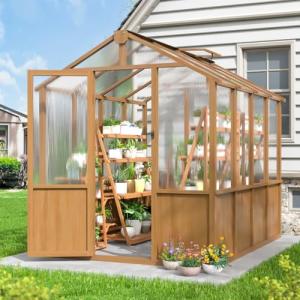
This large walk-in greenhouse features a lockable door for convenient access and security against theft.
The lockable door serves multiple practical purposes beyond the obvious security function. Locking the door prevents opportunistic pest access — foxes, rabbits, and deer will investigate any structure that smells of fresh growth, and a secured entry keeps them from discovering your seedlings. It also allows you to confidently regulate internal temperature during cold snaps, knowing the door won't be nudged open by wind or wildlife during the night.
The walk-in door height is generous enough to enter comfortably upright while carrying tools or trays of plants. This sounds like a basic requirement, but it's one that cheaper greenhouse designs frequently sacrifice, forcing gardeners to stoop and shuffle — particularly frustrating when your hands are full.
The interior can be furnished with a coffee table and other furniture to create a cosy space — a detail that reflects the AirWire's positioning as something more than purely functional growing infrastructure. At 128 square feet, there is genuine room to dedicate a corner to a potting bench, a folding chair, and shelving without compromising your planting area. Many owners use their greenhouse as an outdoor room during cooler months — a place to work among plants when the open garden is too wet or cold.
Setup and Stability Considerations
Assembly of a structure at this scale requires planning and ideally two people. The modular panel system means components are manageable in size, but the overall footprint requires careful levelling of the base before construction begins. A greenhouse floor that isn't level will create uneven stress on the frame and potential gaps in panel sealing — investing time in a flat, stable foundation pays dividends in structural integrity for years.
Anchoring is strongly recommended. At 8×16 feet, the AirWire presents a significant surface area to wind. Most experienced greenhouse owners bolt or stake their structures to a concrete slab, compacted gravel base, or purpose-made ground anchors. This isn't a design shortcoming — it's standard practice for any outdoor structure of this size. The hardware included with the AirWire supports anchoring to a prepared base.
Comparison: AirWire 8×16 vs. Key Competitors
| Feature | AirWire 8×16 Cedar | Yardenaler 8×16 | Backyard Discovery Zalie 11×7 | Veikous 8×16 Aluminium |
|---|---|---|---|---|
| Frame Material | Cedar + Aluminium Alloy | Pine Wood | Cedar | Aluminium |
| Panel Type | Twin-wall Polycarbonate | 6mm Polycarbonate | Polycarbonate | Polycarbonate |
| Floor Space | 128 sq ft | 128 sq ft | 77 sq ft | 128 sq ft |
| Lockable Door | ✅ Yes | ✅ Yes | ✅ Yes | ✅ Yes |
| Roof Vent | ✅ Adjustable | ✅ Adjustable | ✅ Yes + Exhaust Fan | ✅ Adjustable |
| Thermal Mass Benefit | ✅ Cedar frame | ✅ Pine frame | ✅ Cedar frame | ❌ Metal only |
| Interior Room Style | Walk-in, furnishable | Walk-in | Walk-in | Walk-in |
| Natural Aesthetics | ✅ Premium brown cedar | Mocha brown | Brown cedar | ❌ Grey metal |
| Year-Round Use | ✅ Designed for it | ✅ Yes | ✅ Yes | ✅ Yes |
| Moisture Resistance | ✅ Cedar is naturally resistant | Moderate | ✅ Cedar | ✅ Metal (no rot) |
The AirWire's primary advantage over pure aluminium competitors is its thermal and aesthetic profile — cedar's natural insulating properties and warm visual character are genuinely difficult to replicate with metal. Against pine-frame alternatives, the cedar distinction matters in longevity and moisture resistance, as cedar's natural oils provide meaningful protection against the rot that eventually affects untreated pine in outdoor environments.
The Backyard Discovery Zalie, while offering an exhaust fan, covers significantly less growing area at 77 square feet — barely 60% of the AirWire's footprint. For gardeners who are serious about production growing rather than hobbyist cultivation, the space difference is substantial.
Who This Greenhouse Is Built For
The AirWire 8×16 Cedar sits at a specific point in the greenhouse market. It's not the cheapest option — there are polycarbonate-and-aluminium kits available at lower price points. It's not the most elaborate — purpose-built garden rooms with heating, electricity, and automated venting exist at multiples of the price.
What it is, precisely, is the right greenhouse for the gardener who takes their growing seriously, wants a structure that adds to the aesthetic of their outdoor space rather than detracting from it, and needs genuine year-round growing capacity in a footprint that fits a typical residential backyard.
The combination of cedar's natural warmth and durability, the efficiency of twin-wall polycarbonate panels, thoughtful ventilation design, and a generous 128-square-foot interior makes this a greenhouse that will reframe how you garden — not just for one season, but for the years ahead.
Final Verdict
The AirWire 8×16 FT Wooden Greenhouse doesn't ask you to choose between form and function. The cedar frame is structurally superior to aluminium in thermal terms and visually superior in every context. The polycarbonate panels deliver the insulation and light diffusion that plants actually need. The lockable door, adjustable roof vent, and walk-in proportions reflect the requirements of genuine growing practice rather than a marketing checklist.
For gardeners ready to graduate from seasonal limitation to year-round growing — and who want a structure they're proud to have in their garden rather than one they merely tolerate — the AirWire 8×16 is a considered, capable choice.
View the AirWire 8×16 FT Wooden Greenhouse on Amazon →