Every great garden has a skeleton. Not the visible one of plants and perennials, but the architectural one — the trellises, pergolas, arches, walls, and fences that give a garden its fundamental shape, its reason for being, its sense of place even in the dead of winter when every leaf has gone and the soil lies bare.
Garden structures are, in many ways, the most underrated element in outdoor design. Homeowners spend thousands on rare specimens, on soil amendments, on irrigation systems — and yet they neglect the pergola that would frame the entire property, or the simple stone wall that would transform a flat lawn into a garden with genuine drama. It's a curious oversight, because garden structures do more heavy lifting per square foot than almost anything else you can invest in.
The best garden designers have always known this. Gertrude Jekyll, who transformed English garden design in the early twentieth century, worked in deliberate partnership with architect Edwin Lutyens. He built the bones; she dressed them. The result was a series of gardens that felt both natural and intentional, wild and controlled — because the structures gave the planting somewhere to go, something to respond to.
That principle hasn't aged a day.
What We Mean by Garden Structures
Before going further, it's worth defining the territory. Garden structures cover a broad family of elements:
Hard structures include walls, fences, raised beds, steps, terracing, paths, pergolas, gazebos, and arbours. These are largely permanent features — built from stone, brick, timber, steel, or a combination — that form the fixed framework of a garden.
Soft structures include trellises, obelisks, arches, and plant supports. These are often more temporary or moveable, though no less important to the overall composition.
Transitional structures — gates, doorways, moon gates, hedges cut into formal shapes — occupy the interesting middle ground between architecture and planting. They define space without enclosing it completely.
All of these, used well, serve the same fundamental purpose: they organize space, create experience, and give a garden a legible sense of design.
Structure Before Planting: Getting the Order Right
One of the most common mistakes in garden design is approaching planting before structure. It feels intuitive to start with plants — they're alive, they're appealing, they're the reason most of us garden in the first place. But designing planting without structural bones in place is like furnishing a room before deciding where the walls go.
Structure should come first, or at least be planned simultaneously. This is not a constraint on creativity — it's an enormous liberation. When you know where the pergola will sit, you know where the main axis of the garden runs. When you know where the raised beds will be, you understand how the paths between them will work and how human bodies will move through the space. When you know the walls, you understand the microclimates you're working with.
Getting structure right early also means your garden will look designed even in its infancy. New planting can look sparse and tentative for the first two or three years. But a well-placed pergola looks right from day one. A beautifully constructed dry-stone wall commands attention and respect before a single plant grows near it.
Pergolas: The Grand Gesture
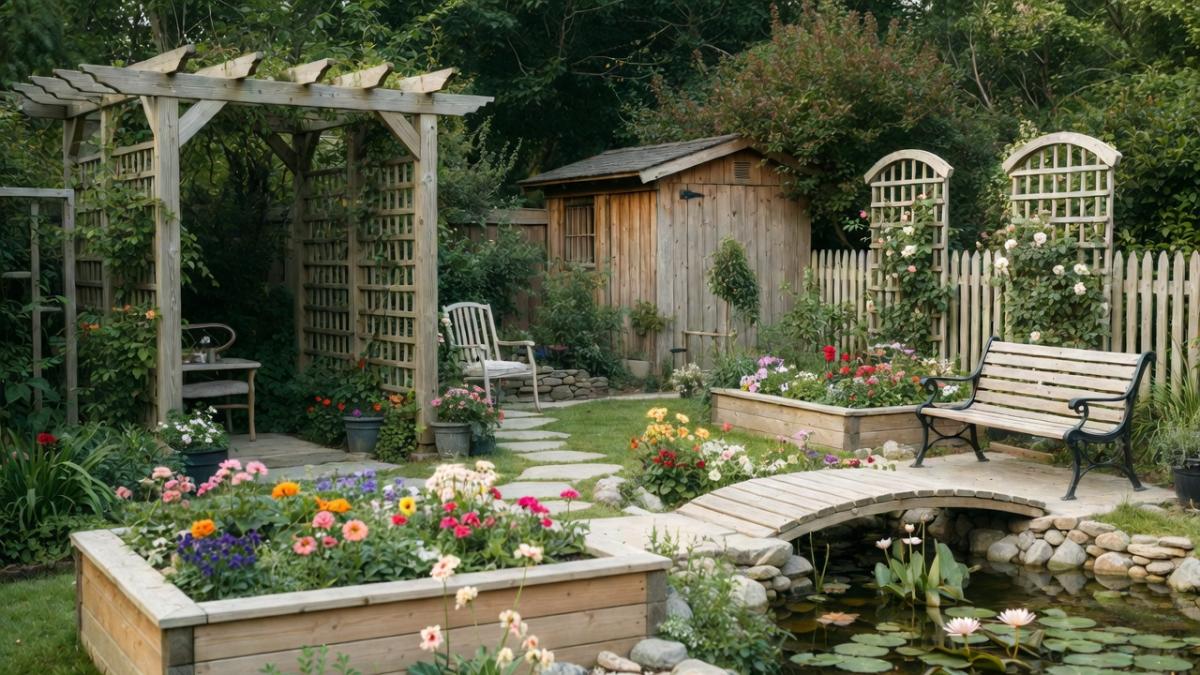
Few structures do more for a garden than a well-designed pergola. At its most functional, a pergola is simply a series of vertical posts supporting overhead beams — an outdoor room with a ceiling but no walls. In practice, a good pergola transforms everything around it.
A pergola creates destination. In a garden without strong structure, there is often no clear reason to move from one part of the space to another — you simply wander. A pergola changes that. It creates a place, a room, somewhere to walk toward and linger within. It answers the question every garden visitor has, consciously or not: where am I going?
A pergola also creates enclosure without confinement. This is one of the most subtle and satisfying spatial experiences a garden can offer. You are outside, under open sky on all sides, and yet you feel held, sheltered, protected. The vertical posts and horizontal beams create a psychological boundary that doesn't require solid walls to feel real.
When planted with climbing roses, wisteria, jasmine, or clematis, a pergola becomes something more still. The structure disappears beneath the planting while still doing its structural work beneath. The plants have height, context, and support. The humans underneath have scent, filtered light, and beauty overhead. It is one of the great win-win arrangements in garden design.
The key to a successful pergola is proportion. Too low and it feels oppressive; too high and it loses its intimacy. The standard advice — minimum 2.4 metres clear height, beams extending generously beyond the last posts — holds for a reason. Scale it generously. Pergolas that are slightly too large almost always look better than those that are slightly too small.
Walls and Fences: Enclosure as Design
There is a reason that the word "paradise" comes from the Persian word for "walled garden." Enclosure is fundamental to the garden experience. Walls and fences don't just mark boundaries; they create the conditions under which a garden can exist as a distinct world, separate from whatever lies beyond it.
A solid boundary — a mellow brick wall, a dry-stone wall built in local materials, a rendered wall painted in a thoughtful colour — does several things at once. It provides privacy and shelter. It creates microclimates: south-facing walls trap heat and allow tender climbers to thrive in climates where they otherwise wouldn't survive. It gives vertical planting surfaces that extend the garden into three dimensions. And it provides a backdrop that makes planting in front of it infinitely more legible and beautiful.
Consider the classic English walled garden. Its walls aren't incidental; they are the garden. The entire planting logic — espaliered fruit trees, cutting borders, kitchen beds, the long perennial borders — flows from the existence of those walls. The walls determine the light, the shelter, the aesthetic register, and the spatial experience. Without them, you simply have a field.
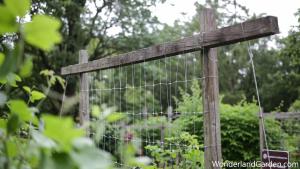
Fences operate differently. They offer transparency where walls offer solidity, and this transparency can be used deliberately. A well-designed picket fence — or a more contemporary steel wire fence — allows borrowed views into neighbouring landscapes or fields while still defining the garden's boundary. Post-and-rail fencing in a rural setting gives structure without interrupting the visual flow outward. Fences are often the right answer in gardens that want to feel open while still feeling organised.
The choice between wall and fence is partly aesthetic, partly functional, and partly financial. Walls are expensive to build well but will last centuries and increase dramatically in beauty as they age. Fences are cheaper, more flexible, and more easily changed. Both are infinitely better than no boundary at all.
Arches and Gateways: The Art of the Threshold
An arch does something architecturally precise and psychologically powerful: it marks a threshold. It says, clearly and without ambiguity, that you are moving from one space into another. In garden design, this is an extraordinarily useful tool.
Gardens that lack clearly defined spaces often feel like single, undifferentiated areas — pleasant perhaps, but lacking depth and narrative. The experience of moving through such a garden is flat. You see everything at once, and there is nothing more to discover.
Arches change this. A metal arch clothed in climbing roses, positioned at the gap in a hedge, transforms what could be a simple passage into an event. You anticipate what lies beyond. You slow down slightly, move through the frame, and experience the revelation — however modest — of what waits on the other side. This is garden design working at its most experiential, and it costs relatively little to achieve.
Gates amplify the effect further. A gate says that what lies beyond is intentional, curated, worth entering. Even a simple timber gate in a garden wall creates a sense that the space beyond it has been thought about, designed, cared for. It raises anticipation and, importantly, it invites people to make an active decision to enter — which makes the experience of the space feel more meaningful once they're inside.
Repeated arches in sequence — a series of metal or timber arches creating a tunnel — create one of the most theatrical effects possible in a garden. The tunnel compresses and elongates space simultaneously, pulling the eye toward whatever lies at its end. This is a centuries-old trick, used in the great gardens of France, Italy, and England, and it works as well in a suburban back garden as it does at Versailles.
Raised Beds: Structure That Serves
Raised beds are sometimes thought of purely in functional terms — better drainage, easier access, contained soil management. All of that is true, but it undersells them as design elements considerably.
A well-constructed raised bed is a piece of hard landscaping. Built in oak, in Corten steel, in reclaimed brick, or in rendered concrete, raised beds introduce strong geometric forms into the garden that organise planting and give the space a clear sense of intention. They define paths between them. They create height variation in what might otherwise be a flat garden. They divide the garden into zones without enclosing those zones completely.
Vegetable and kitchen gardens, in particular, are transformed by thoughtful raised bed design. The traditional kitchen garden — rows of vegetables in open ground — has a certain agricultural honesty, but it rarely looks beautiful. The same vegetables grown in well-proportioned raised beds arranged in a formal pattern, with brick or gravel paths between them, a central focal point, and perhaps an arch or two for climbing crops, looks designed. It feels intentional. It is, in the best sense, a garden rather than a plot.
The height of raised beds matters enormously. Beds at 20–30cm serve primarily to contain soil and define space. Beds at 60–90cm become genuinely accessible without bending, extend planting into a more vertical plane, and create stronger visual impact. The right height depends on the garden, the user, and the aesthetic intention.
Obelisks and Plant Supports: The Vertical Dimension
A flat garden — one where all the planting sits at roughly the same height — is a common design problem. It lacks drama, it lacks depth, and it typically lacks the height necessary to create the sense of being enclosed and surrounded by the garden rather than simply looking at it.
Obelisks, plant supports, and garden structures devoted specifically to vertical planting solve this directly. A tall timber or metal obelisk in a border gives sweet peas, clematis, or climbing roses a place to go. It draws the eye upward. It creates a focal point within the planting itself — not just at the edges of the garden, but within its interior.
The best obelisks are beautiful objects in their own right, not merely functional props. A well-crafted iron obelisk in a perennial border looks good even before anything has climbed it. The patina of weathered steel, the geometry of the form, the way it catches light — these are genuine aesthetic contributions to the garden.
Spacing obelisks in a repeated rhythm along a border creates something more ambitious still: a sense of architectural order within apparently informal planting. This is a technique used in many of the great herbaceous borders, and it gives even loosely planted gardens a sense of designed intelligence.
Gazebos and Garden Rooms: Destination and Enclosure
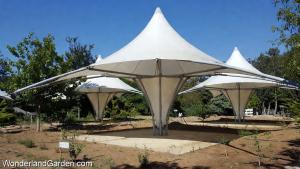
A gazebo — the term covers everything from a simple timber summerhouse to an elaborate open-sided pavilion — creates the strongest possible destination in a garden. It is a room. It is a place to be, not just to pass through.
The positioning of a gazebo is a critical design decision. Placed at the far end of a garden, it creates an axis — a reason for the garden's primary path to exist, a goal for every journey across the space. Placed in a corner, it creates an intimate retreat. Placed centrally, it becomes the heart around which the garden's geometry organises itself.
In design terms, a gazebo does something that no plant can do: it provides a fixed, year-round focal point. In winter, when borders are empty and trees are bare, a well-proportioned pavilion or summerhouse holds the garden together. It proves that someone lives here, that this space is cared for, that winter is a pause rather than an ending.
The interior of a gazebo matters too. Furnished simply — a table, a few chairs, perhaps a lantern — a gazebo becomes genuinely usable outdoor space. And usable space is, ultimately, what garden design is in service of. Structure creates the conditions for life.
Paths and Steps: Circulation as Design
Paths are structures. This is worth saying clearly because paths are often treated as mere practicalities — ways to move from A to B without getting mud on your shoes. In fact, a well-designed path is one of the most powerful compositional tools in garden design.
A path determines how a garden is experienced. A straight path says: go directly, efficiently, from here to there. A curved path says: slow down, take in the sides, let the destination reveal itself gradually. A path that curves out of sight suggests a garden with more to offer than is immediately visible — which is one of the oldest and most effective tricks in the design handbook.
The material of a path matters as much as its shape. Gravel paths are informal, slightly soft underfoot, good for drainage, and easy to lay in curves. Stone flags or brick paths are more formal, more permanent, more suited to axes and straight lines. Grass paths — mown strips through longer grass or meadow planting — have a quality of naturalness and ease that hard-surface paths cannot replicate.
Steps, where level changes are unavoidable, deserve particular attention. Steps in a garden are not just functional transitions between levels — they are opportunities for drama, for the staging of plants, for the creation of a moment that marks the change from one part of the garden to another. Wide, shallow steps in stone or brick, with planting softening their edges, are among the most beautiful elements a garden can contain.
Structures and Sustainability
Modern garden design increasingly asks that structures serve ecological as well as aesthetic functions. Here, garden structures earn their place in multiple ways.
Walls and fences create shelter that extends the growing season and allows plants to thrive that would otherwise struggle. Raised beds allow precise control of soil conditions, reducing the need for amendments across a larger area. Structures supporting climbing plants increase a garden's plant density and therefore its value to insects, birds, and other wildlife without requiring additional ground area.
Timber structures — pergolas, fences, raised beds — built from sustainably sourced wood or reclaimed timber have a genuine environmental credential. Corten steel, though energy-intensive to produce, lasts decades without painting or maintenance and develops a beautiful patina over time. These are long-term investments that amortise their environmental cost over many years of useful life.
There is also something to be said for the simple sustainability of building things that last. A well-built dry-stone wall will stand for two or three centuries. An oak-framed pergola, properly detailed, will outlast its builder by generations. The temporariness of much garden design — the replanting every few years, the constant churn of trends and fashions — is not sustainable in the most basic sense. Structures that endure, that age well, that become more beautiful over time, are an inherently sustainable investment.
The Sum of the Parts
The argument for garden structures is, in the end, the argument for design itself. Plants are the emotional content of a garden — the colour, the scent, the texture, the life. But structures are the grammar through which that content becomes intelligible. Without grammar, even the most beautiful words are just noise.
A garden organised by strong structure is a garden that can be fully planted, fully experienced, and fully inhabited. It has rooms and routes, destinations and thresholds, enclosure and openness. It works in all seasons, at all stages of growth, in the hands of a gardening obsessive and in the hands of someone who only gets outside on weekends.
Getting structures right is not the most glamorous part of garden design. Choosing climbing roses for a pergola is considerably more fun than specifying the timber section and the bolt fixings. But the roses depend on the pergola. The pergola depends on the posts and the foundations. The foundations depend on the decision, made clearly and early, that this is where the garden's main axis will run and this is where its destination will be.
Make that decision. Build the bones. The rest — the planting, the seasonality, the gradual and deeply satisfying process of a garden growing into itself — will follow.
And in ten years, when the wisteria has consumed the pergola and the dry-stone wall has softened under a decade of moss, you will understand exactly why structure comes first.
Good garden design begins not with what you plant, but with what you build.