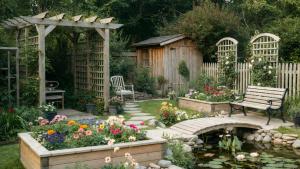
There's a particular cruelty to summer in a garden. You spend months coaxing things into growth — the perennials, the raised beds, the lovingly curated seating area — and then June arrives with its merciless angle of light and turns your outdoor sanctuary into something closer to an open-air oven. The herbs bolt. The lettuce burns. The chairs sit empty through the hottest part of the afternoon because no sane person would voluntarily sit in direct sun when the thermometer reads 95°F.
The solution isn't to retreat indoors and watch the garden through a window. The solution is shade — deliberate, designed, and chosen to suit both the function of your space and the character of your garden. But shade is not a single thing. Between a simple market umbrella and a full timber pergola lies a whole spectrum of options with wildly different aesthetics, costs, lifespans, and practical implications. Getting it right means understanding not just what's available, but what each structure actually does to a space, how it handles wind and rain, and whether you'll still want to look at it in five years.
This guide works through all of it, from the flexible and portable to the architecturally permanent, with an honest accounting of the tradeoffs.
The Case for Intentional Shade
Before diving into specific structures, it's worth making a distinction that often gets lost in the excitement of shopping: passive shade and designed shade are fundamentally different experiences.
Passive shade is what you get from a large tree or a neighboring building — it happens to you. Designed shade is what you create on purpose, positioned to cool the spaces where people actually sit and gather, oriented to block the afternoon sun (which, in the northern hemisphere, arrives from the southwest and is far more aggressive than morning light), and structured to withstand the specific conditions of your garden.
A tree takes twenty years to mature. A structure takes a weekend. And while trees have their own irreplaceable value — habitat, air quality, the sound of wind through leaves — they're not actually a substitute for built shade when you need to cool a specific 12x16 foot patio by Tuesday afternoon.
The best summer gardens usually have both: trees positioned thoughtfully around the perimeter for ambient cooling, and at least one dedicated shade structure that defines the primary gathering space.
Pergolas — The Backbone of Garden Architecture
If there's a single shade structure that has dominated garden design for the past two decades, it's the pergola. And with good reason: a well-built pergola does something that most other shade structures don't. It creates architectural definition. It says this is a room, even when that room has no walls and no ceiling in the traditional sense.
A pergola is essentially a series of vertical posts supporting an open lattice or beam framework overhead. The overhead structure filters light rather than blocking it entirely, creating dappled conditions that are cooler than full sun but brighter than solid shade. This makes pergolas ideal for dining areas where you want ambiance along with relief from direct overhead sun.
The material you choose matters enormously.
Timber pergolas — particularly cedar, redwood, or Douglas fir — have warmth and authenticity that aluminum will never replicate. They weather to beautiful silver-grey if left untreated, or can be stained to maintain a richer color. The tradeoff is maintenance: wood pergolas need periodic sealing or staining, and in humid climates they're vulnerable to rot at the post bases unless you use appropriate ground contact ratings and metal post bases that keep the wood out of direct soil contact.
Aluminum and powder-coated steel pergolas require far less maintenance. They don't rot, they don't warp, and the modern versions have shed the industrial look that plagued early metal pergolas. Many now come in kits that a competent DIYer can install in a weekend. The criticism is that they feel slightly anonymous — they don't age into a garden the way wood does.
Vinyl pergolas occupy an uncomfortable middle ground. They're maintenance-free but often look it, lacking the visual weight and craftsmanship of timber or the clean precision of quality metal.
One trend worth watching: bioclimatic pergolas with adjustable louvered roofs that can be opened for breeze and dappled light, then closed to provide rain protection. These are significantly more expensive than traditional pergolas — quality motorized louver systems start around $3,000 and scale up steeply — but they turn a pergola from a fair-weather structure into something usable across three seasons.
For climbing plants, a pergola becomes more than a shade structure. Wisteria, climbing roses, Virginia creeper, and hops will colonize the overhead framework and create genuine green canopy within a few seasons. This is, for many gardeners, the ultimate goal: a living roof of fragrant, flowering growth that provides shade as a byproduct of being beautiful.
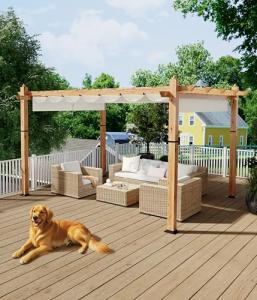
GarveeLife 10x13 ft Aluminum Pergola with Canopy
Create your perfect outdoor oasis with this stylish and durable aluminum pergola featuring an adjustable canopy for shade and comfort
Product information
Product Review Score
4.43 out of 5 stars
217 reviewsProduct links
Shade Sails — Geometry Meets Function
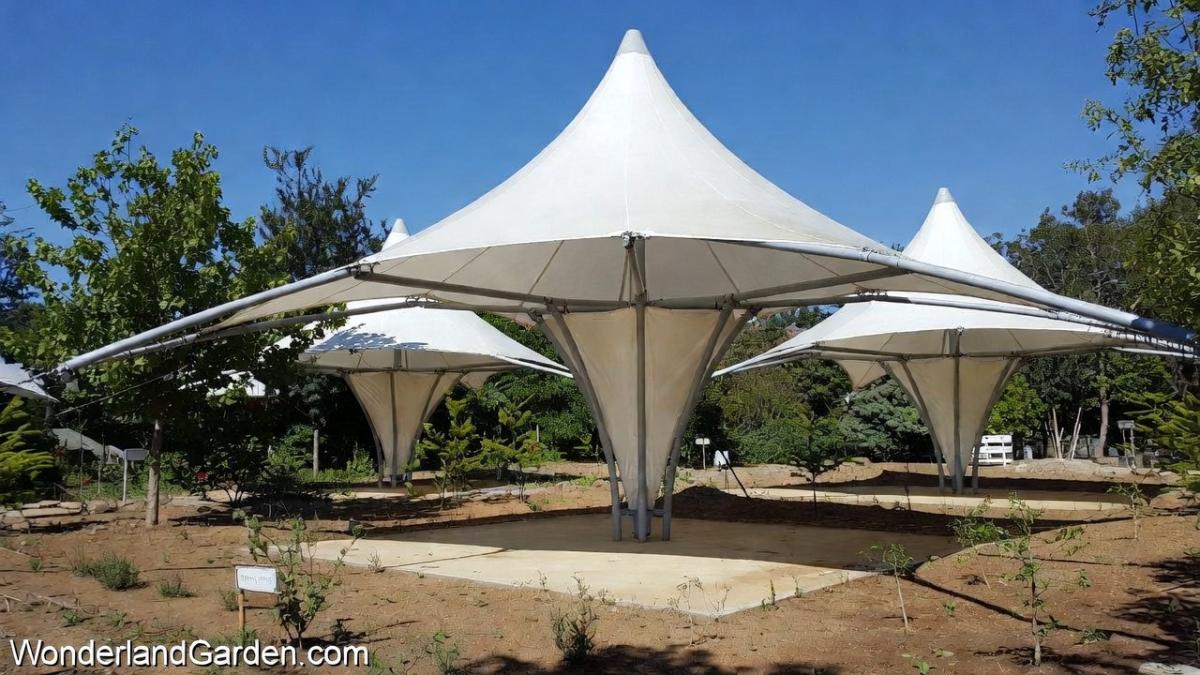
Shade sails have had a remarkable trajectory from institutional space-filler to genuine design statement. They started in playgrounds and commercial outdoor spaces, where their tensioned triangles and quadrilaterals were valued primarily for UV protection and durability. Today, they're a legitimate design choice in residential gardens, used to create dynamic overhead geometry that adds visual interest even when you're not sitting under them.
The appeal is flexibility. You're not committed to a fixed structure over a fixed point — you're running tensioned fabric between anchor points that can be posts, walls, tree trunks, or existing structures. Multiple sails can be layered and overlapped to create more complete coverage than a single panel would provide. The color and shape choices are genuinely diverse, from crisp white triangles that feel Mediterranean to warm terracotta rectangles that read more like a Moroccan riad.
The fabric itself is the critical specification. Look for high-density polyethylene (HDPE) shade cloth with a UV stabilizer rating and a tight enough weave to block at least 90% of UV rays. Cheaper sails lose their color and structural integrity within two or three seasons. Quality commercial-grade sails from manufacturers like Shade Systems or ShadeFX can last a decade with proper care, which means removing them for winter storage in climates with significant snow or ice load.
The honest limitations: Shade sails don't provide rain protection. In a downpour, they become water-collecting funnels if they're not angled steeply enough, and even with proper pitch, water pooling and then draining is not a pleasant experience for anyone sitting beneath. They also require substantial anchor points — the tensioning forces involved in a properly installed sail are significant, and the posts or wall anchors need to be engineered accordingly. An improperly anchored sail can fail dramatically in high wind.
Installation is also more complex than it appears. The geometry of getting multiple anchor points at the right heights to create proper tension and drainage slope involves more trigonometry than most weekend projects. Many people hire this out, which adds to the cost.
Retractable Awnings — The Pragmatic Choice
There is something fundamentally satisfying about a retractable awning. You extend it when you need shade; you retract it when you don't. There's no taking down panels for winter, no wrestling with shade sail attachment points, no wondering whether today's wind is too strong for the umbrella.
Retractable awnings are mounted to the exterior wall of a house and project outward over a patio or deck, supported by articulating arms that fold back against the wall when not in use. The better ones are motorized and can be integrated with wind sensors that automatically retract the awning when gusts exceed a set threshold — which is a genuinely important safety feature, since awnings are surprisingly vulnerable to wind damage when extended.
The coverage area is fixed by the mounting position and the projection length, which typically ranges from six to fourteen feet. This suits patios that are immediately adjacent to the house. For standalone seating areas or structures away from the building envelope, retractable awnings don't work.
Fabric selection matters both aesthetically and practically. Solution-dyed acrylic fabrics — the industry standard is Sunbrella — resist fading, mildew, and UV degradation far better than cheaper polyester alternatives. They come in hundreds of patterns and solid colors. The pattern you choose will be highly visible from inside the house when the awning is extended, so it's worth thinking about how it reads through your windows.
Cost for retractable awnings varies widely. A manual awning for a modest patio might be purchased and installed for around $1,500. A motorized system with wind sensing, LED lighting integration, and a twelve-foot projection can run $5,000 to $8,000 installed. The installed cost is significant because wall mounting involves finding studs, potentially flashing around the mount point to prevent water intrusion, and running electrical for motors and sensors.
The payoff is convenience that's genuinely transformative. Households with retractable awnings report using their outdoor spaces significantly more often than those without, simply because the friction of creating shade has been reduced to pressing a button.
Garden Umbrellas — Don't Underestimate Them
The humble patio umbrella gets overlooked in conversations about serious shade structures, which is a mistake. A quality large-format umbrella provides substantial shade, can be repositioned as the sun moves, and represents a fraction of the cost of permanent or semi-permanent structures.
The key word is quality. The $79 umbrella from a big-box store will last one season if you're lucky. The frame will bend, the fabric will fade, and the tilt mechanism will seize. A $400 to $600 commercial-grade umbrella with an aluminum or hardwood pole, marine-grade fabric, and a proper weighted base is a completely different object that can last ten or more years.
Cantilever umbrellas deserve special mention. Unlike center-pole models that require a hole in your table, cantilever designs mount the pole to the side and project the canopy overhead from an offset arm. This leaves the area beneath completely clear, which is both aesthetically cleaner and functionally more flexible — you can position furniture however you like without working around a central pole. The tradeoff is that cantilever models place significant torque on the base, which needs to be heavy (often 150 to 200 pounds of weighted base) to prevent tipping.
For seating areas where you want to shift coverage throughout the day as the sun moves, a pair of high-quality cantilever umbrellas gives you more flexibility than any fixed structure. It's a solution often underestimated by people who've only ever used cheap umbrellas.
Gazebos and Pavilions — When You Want a Room
A gazebo is a shade structure with ambitions. It has a complete roof, defined walls (or at least defined corners), and enough enclosure to feel genuinely architectural rather than simply decorative. A well-positioned gazebo becomes the organizing element of a garden — everything orients toward it or away from it.
Traditional gazebos are octagonal with pitched roofs, often in painted wood with decorative rafter tails and perhaps a cupola at the peak. These are beautiful in the right setting — a large, established garden with a traditional aesthetic — and feel slightly awkward in a contemporary minimalist space. The pavilion form (rectangular, flat or gently pitched roof, cleaner lines) has largely replaced the classical gazebo in modern garden design.
Permanent pavilions built from timber frame or steel are genuinely architectural additions to a property, with commensurate costs. A quality timber-frame pavilion designed and built by a professional contractor will run $15,000 to $50,000 depending on size and complexity. This is a serious investment that requires permits in most jurisdictions and adds to assessed property value.
Kit gazebos from manufacturers like Yardistry or Lifetime occupy the middle market at $2,000 to $8,000. They're generally solid structures that a capable DIY team can assemble over a weekend, but the design is fixed by the kit, and the materials — often cedar or powder-coated aluminum — while adequate, lack the character of custom work.
The functional advantage of a gazebo or pavilion over open-framework structures is complete overhead protection. You can use a pavilion in light rain, in strong sun, and into the evening with string lights overhead. It's the closest outdoor equivalent to a room, which is exactly what makes it appropriate for permanent outdoor kitchens, dining areas, or hot tub enclosures.
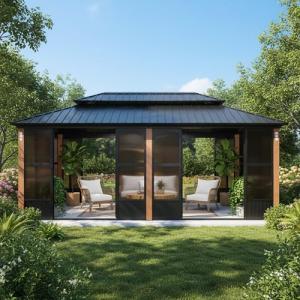
Purple Leaf 12' x 20' Hardtop Patio Gazebo
Transform your outdoor space into a stylish retreat with this spacious and durable hardtop gazebo
Product information
$5,299.99
Product Review Score
4.34 out of 5 stars
214 reviewsProduct links
Green Shade — Living Structures and Trellises
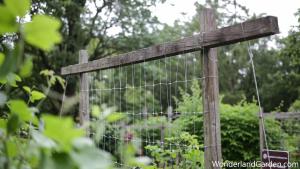
Before there were shade sails and retractable awnings, there were arbors and trellises, and they've never been less relevant than they are right now.
A simple timber arbor — four posts, two beams, and a lattice overhead — planted with a vigorous climber creates natural shade within two or three growing seasons. This isn't a temporary solution; it's a permanent landscape feature that improves with age in ways no manufactured product can match.
The best climbers for overhead shade:
Wisteria creates extraordinary canopy density and spring flower displays of almost theatrical beauty. It's also genuinely aggressive: it will engulf a poorly built structure, so the framework needs to be robust.
Kiwi vine (Actinidia deliciosa) grows vigorously, provides dense leaf cover, and produces edible fruit in sunny climates. The large leaves create cooling shadow in summer while going dormant in winter, allowing light back into the space when you need it.
Hops (Humulus lupulus) grow astonishingly fast — up to a foot per day during peak season — and die back completely each winter. If you want rapid overhead cover from a perennial climber, hops are hard to beat, and their ornamental value in a garden setting is underappreciated.
Climbing hydrangea (Hydrangea anomala petiolaris) is slower to establish but extraordinarily beautiful when mature, and it tolerates partial shade, making it suitable for structures that receive mixed light.
The philosophical advantage of living shade is that it participates in the ecology of the garden rather than simply sitting on top of it. Pollinators visit the flowers. Birds nest in the dense growth. The structure has a natural quality that no manufactured product achieves, regardless of how elegant its design.
Comparison of Shade Structure Types
| Structure | Cost Range | Permanence | Rain Protection | Installation | Lifespan |
|---|---|---|---|---|---|
| Timber Pergola | $3,000–$15,000 | Permanent | ✗ Open | Professional/DIY | 15–30+ years |
| Shade Sail | $200–$2,000 | Semi-permanent | Partial | DIY/Professional | 5–10 years |
| Retractable Awning | $1,500–$8,000 | Semi-permanent | ✓ Good | Professional | 10–15 years |
| Cantilever Umbrella | $300–$1,500 | Portable | Partial | DIY | 5–10 years |
| Gazebo/Pavilion | $2,000–$50,000 | Permanent | ✓ Full | Professional | 20–50+ years |
| Bioclimatic Pergola | $4,000–$20,000 | Permanent | ✓ Full (closed) | Professional | 15–25 years |
| Living Arbor/Trellis | $500–$5,000 | Permanent | Partial | DIY | 20+ years |
| Center Pole Umbrella | $80–$600 | Portable | Partial | DIY | 1–10 years |
Siting, Orientation, and the Physics of Summer Sun
The most beautiful shade structure in the world fails if it's positioned in the wrong place. Understanding solar geometry isn't as complicated as it sounds, and getting it right is the difference between a structure you use constantly and one that looks good in photographs but leaves you squinting every afternoon.
In the northern hemisphere, the sun tracks across the southern sky. Morning light arrives from the east, afternoon light from the west, and the most intense midday light comes from the south at a relatively high angle (the higher the latitude, the lower the angle). The most uncomfortable sun — the kind that makes you retreat indoors — is the low-angle western light of late afternoon, arriving directly into your eyes and retaining all the heat it's accumulated throughout the day.
For a patio adjacent to the house: A south-facing patio gets intense midday sun. A west-facing patio gets brutal afternoon sun and is the most urgent candidate for shade. An east-facing patio gets pleasant morning light and is naturally shaded by early afternoon. A north-facing patio in full shade needs supplemental light more than shade.
For standalone structures: Site your primary shade structure so that its shadow falls on the gathering area during the hours you most use it. For most households, that's roughly 11am to 4pm. Use a sun calculator app (SunCalc.org is excellent and free) to visualize exactly where shadows will fall at different times and dates before you commit to post placement.
Wind exposure is the other critical site consideration. A pergola or shade sail in an exposed position is a different installation challenge than the same structure in a sheltered garden. Fabric structures particularly need to account for prevailing wind direction — a shade sail that catches wind like a kite in a summer storm is a liability.
Material Longevity and the True Cost of Shade
A $500 umbrella that lasts ten years costs $50 per year. A $12,000 timber pergola that lasts thirty years costs $400 per year. A $200 pop-up shade canopy that lasts one season costs $200 per year. Thinking in terms of annualized cost changes the calculus considerably, and it's worth doing the math before assuming that a cheaper structure is actually the economical choice.
Maintenance costs are equally worth factoring in. A cedar pergola needs refinishing every three to five years — call it $300 to $600 in materials and time per treatment, or hire it out for more. A shade sail needs to be stored in winter and inspected annually for fabric degradation. A motorized awning needs its motor and electrical components checked occasionally and the fabric cleaned.
The structures that genuinely win on lifetime cost are usually either the simple portable options (an umbrella that you replace every decade) or the substantial permanent structures (a well-built pergola or pavilion that outlasts your ownership of the property and adds resale value). The middle market — kit gazebos, entry-level retractable awnings — often disappoints on both fronts.
Integrating Shade With the Rest of the Garden
A shade structure doesn't exist in isolation. It's a focal point, a spatial anchor, and potentially a visual element that's visible year-round. Getting the aesthetics right matters as much as getting the engineering right.
Color and material continuity between the shade structure and the adjacent built environment — the house, fencing, raised beds, hardscape materials — creates cohesion. A natural cedar pergola that reads against cedar fencing and stone paving feels integrated. The same pergola in a garden full of painted white picket fencing and brick might feel like a visitor from another project.
Lighting transforms a shade structure from a daytime amenity into an evening one. String lights woven through pergola beams have become almost obligatory, and while the look has been somewhat diluted by ubiquity, it remains genuinely effective. The better option, if you're building or renovating, is to hardwire recessed fixtures or pendant lights into the overhead structure — it's cleaner, more controllable, and more durable than temporary festoon lighting.
Outdoor curtains on a pergola or pavilion add a degree of privacy and sun filtration that changes the character of the space completely. Heavy linen curtains caught by a breeze create an atmosphere no umbrella or sail can match. They also provide some lateral sun protection in the late afternoon, which overhead-only structures don't address.
The Decision Framework
After everything, the choice comes down to four honest questions.
How permanent do you want to be? If you're renting, plan to move, or simply want flexibility, portable or semi-permanent structures are clearly right. If you're putting down roots and want to invest in the garden as a long-term asset, permanent structures make sense and will pay back in daily usability and property value.
What's your primary discomfort? If it's direct overhead sun at midday, almost any structure helps. If it's low-angle afternoon sun, you need vertical panels or curtains in addition to overhead coverage. If it's heat radiating from a hot paving surface, no amount of overhead shade fully solves it without improving the paving material itself.
How much maintenance are you willing to do? Be honest with yourself here. A beautiful timber pergola with climbing wisteria requires seasonal pruning, periodic refinishing, and genuine horticultural attention. If that sounds like a pleasure, it is. If it sounds like another obligation, choose aluminum.
What does the space need architecturally? A bare patio without vertical definition often needs a pergola more than it needs shade — the shade is a benefit, but the spatial structure is the real transformation. A patio that already has good enclosure might be perfectly served by a well-chosen umbrella.
Closing: Shade as Gardening
There's a tendency to think of shade structures as infrastructure — practical additions that solve a problem but don't contribute to the garden as such. The best ones do the opposite. A pergola draped in wisteria in full bloom is as beautiful as any flowering tree. A well-sited shade sail in a courtyard garden creates geometric interest that reads as art. A living arbor thick with hops in August is the definition of abundance.
Shade is not just a mechanical solution to excessive solar radiation. It's the thing that makes a garden usable during the hours when light and heat are most intense — which, in summer, are often the most beautiful hours of the day. Getting your shade right means you actually live in your garden rather than occasionally visiting it.
That, ultimately, is what every structure in this guide is trying to give you: not just relief from the sun, but a reason to stay outside.