Built Around Cedar — And That Choice Matters
Most budget-tier greenhouses lean on galvanized steel tubing or powder-coated aluminum. Both have their place, but neither one ages gracefully or blends naturally into a garden setting. Cedar is different. As a framing material, it earns its reputation for a reason: natural resistance to rot, insects, and moisture without requiring chemical treatment. Western red cedar, in particular, contains natural oils that act as a preservative from the inside out.
This greenhouse uses a pre-cut and pre-drilled cedar frame, which streamlines assembly considerably. The pieces arrive already shaped and prepped — no measuring, no drilling your own holes, no guessing at angles. The triangular structural design reinforces rigidity at the roofline, which is exactly where wind and snow load do their worst work.
Speaking of which: this frame is rated to withstand winds up to 56 mph and a snow load of 18 psf (pounds per square foot). For context, 18 psf is roughly equivalent to about 18 inches of fresh light snow, or around 8–10 inches of heavier wet snow — the kind that collapses lesser structures without warning. Most pop-up or lightweight aluminum greenhouses don't publish any snow load ratings at all. This one does, and that transparency matters.
The triangular roof structure and the overall weight of the assembled unit also mean you won't need additional wind anchors in most conditions — the greenhouse holds itself down rather than requiring you to stake it into the ground.
The Polycarbonate Panels: More Than Just Walls
The 6mm twin-wall polycarbonate panels are where this greenhouse earns its functional credentials. Polycarbonate is the material of choice in commercial horticulture for good reason — it outperforms glass on nearly every metric relevant to plant growing.
These panels offer 99.99% UV protection, meaning harmful ultraviolet rays are filtered out while the full photosynthetically active spectrum passes through. Plants get what they need; you don't get burned foliage or prematurely degraded seedlings.
The twin-wall construction — two layers of polycarbonate with an air channel between them — acts as insulation. Heat generated inside the greenhouse during the day is retained more effectively than with single-layer plastic sheeting or glass. The trapping effect isn't dramatic enough to replace a heating system in deep winter, but it extends your usable season on both ends: earlier spring starts, later autumn harvests.
The panels are also impact-resistant. Hail, falling branches, and the occasional errant garden tool won't shatter polycarbonate the way glass would. That durability is a real-world advantage that becomes apparent the first time a storm rolls through.
Ventilation Done Right
Overheating kills plants just as reliably as frost. A sealed greenhouse on a sunny July afternoon can spike to 120°F or higher without proper airflow — hot enough to cook seedlings. The adjustable roof vent on this greenhouse addresses that directly.
The roof vent is hinge-secured and opens to a maximum 45-degree angle. That's enough of an aperture to create meaningful convective airflow — hot air rises and exits from the top while cooler air enters at the base. In practice, this means you can manage internal temperatures through manual adjustment rather than relying on expensive automated systems.
The ventilation also controls humidity. Fungal diseases — gray mold, powdery mildew, damping off — thrive in stagnant, moisture-heavy air. Cracking the roof vent after watering dramatically reduces that risk. It's a simple mechanism, but it's one that experienced growers will appreciate immediately.
The Pergola Design: Function Wearing Good Clothes
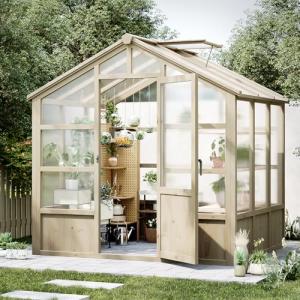
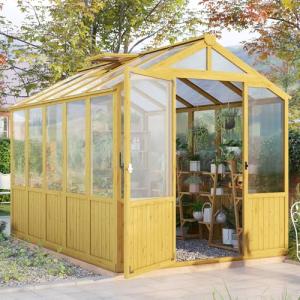
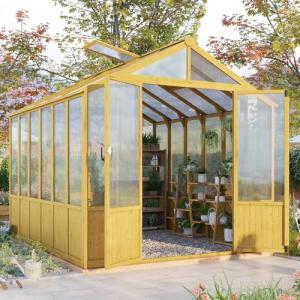
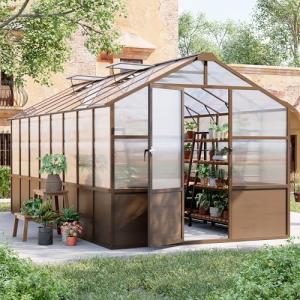
The pergola-style roofline is what sets this greenhouse apart visually from almost everything else in its price range. Where most comparable structures look strictly utilitarian — industrial and anonymous — this one carries an architectural character that reads as intentional backyard design.
The pergola aesthetic, with its clean cedar beams and structured roof pitch, fits naturally alongside garden beds, patios, and outdoor entertaining spaces. It doesn't look like a temporary installation. It looks like someone thought about where it was going and what the yard would look like around it.
That matters more than it might seem. Greenhouses that look good in the yard get used more. They become destinations rather than afterthoughts. The lockable front door and walk-in dimensions mean you can add a potting bench, hang tools, store seed trays, and actually work comfortably inside — turning the structure into a genuine outdoor room rather than a storage tent.
Dimensions, Access & Daily Usability
The numbers: 84.7" wide × 155.5" deep × 96.5" tall. That's roughly 7 feet wide, nearly 13 feet deep, and just over 8 feet tall at the peak. The door opening measures 23.6" wide × 73.2" tall — wide enough to navigate comfortably with flats of seedlings, bags of soil, or a wheelbarrow.
The 8-foot ceiling height is genuinely useful. It accommodates tall-growing crops like indeterminate tomatoes, climbing beans, cucumbers on vertical supports, and even small dwarf fruit trees in containers. Many competing greenhouses in this footprint class top out at 6.5 or 7 feet, which starts to feel cramped quickly once plants hit their stride.
The 104 square feet of interior floor space is enough for two rows of planting beds or shelving with a central aisle. Serious hobby growers will find it a comfortable operating space; beginners will grow into it over several seasons.
The structure ships in 5 boxes, and Wonderland Garden notes these may arrive at different times. It's worth planning for that — don't start assembly until all five boxes are on-site.
Comparing the Competition
When evaluating this greenhouse against the field, context helps. Here's how it stacks up against several comparable models at similar or nearby price points:
| Feature | 8×13 ft Cedar Pergola Greenhouse | Garvee 8×6 ft Wooden Greenhouse | Jocisland 6×8×6.5 ft Greenhouse | Jocisland 8×9.5×7.5 ft Greenhouse | AirWire 8×16 ft Wooden Greenhouse |
|---|---|---|---|---|---|
| Price | $999.99 | $699.99 | $849.99 | $1,234.99 | $959.99 |
| Footprint | 8 × 13 ft | 8 × 6 ft | 6 × 8 ft | 8 × 9.5 ft | 8 × 16 ft |
| Interior Height | 96.5" (~8 ft) | Not specified | 6.5 ft | 7.5 ft | Not specified |
| Frame Material | Cedar | Wood | Cedar | Cedar | Cedar |
| Panel Type | 6mm twin-wall polycarbonate | Polycarbonate | Polycarbonate | Polycarbonate | Polycarbonate |
| Wind Resistance | 56 mph | Not specified | Not specified | Not specified | Not specified |
| Snow Load Rating | 18 psf | Not specified | Not specified | Not specified | Not specified |
| Adjustable Vent | Yes (45° max) | Yes | Yes | Yes | Yes |
| Lockable Door | Yes | Yes | Yes | Yes | Yes |
| Pergola Aesthetic | Yes | No | No | No | No |
| Customer Rating | 4.54 ★ (215 reviews) | 4.72 ★ (118 reviews) | 4.78 ★ (47 reviews) | 4.59 ★ (114 reviews) | 4.71 ★ (155 reviews) |
| Pre-Cut & Pre-Drilled | Yes | Not specified | Yes | Yes | Not specified |
The 8×13 ft Cedar Pergola model wins clearly on raw interior volume relative to its price. The AirWire 8×16 is slightly larger but costs less — though it lacks published structural ratings and the pergola design character. The Jocisland 8×9.5 is smaller and $235 more expensive. For most buyers, the 8×13 represents the clearest value proposition in the lineup.
Who This Greenhouse Is Built For
This is a greenhouse for people who have moved past dabbling. If you've been starting seeds on a windowsill, relying on a cold frame, or struggling through a short growing season with no buffer, this structure changes the calculus entirely.
It's also suited to gardeners who care about how their outdoor space looks — not just how it functions. The cedar frame weathers to a silvery gray patina over time, which actually becomes more attractive as it ages, blending into established garden aesthetics in a way that aluminum never does.
The lockable door makes it secure enough to house expensive tools, irrigation equipment, or propagation setups. The interior volume is generous enough to warrant adding a small folding table and a few grow lights for year-round use. The insulating panels and adjustable ventilation give you genuine climate management capability — not perfect environmental control, but a meaningful buffer against the extremes.
It is, in short, a serious piece of equipment that respects the seriousness of what you're trying to grow.
Assembly Considerations
Pre-cut and pre-drilled cedar makes the build process substantially less intimidating than it might otherwise be. That said, this is a 104-square-foot structure arriving in five boxes — it is not an afternoon solo project. Two people and a clear weekend is a realistic expectation. Having all boxes on-site before you start, laying out parts by section, and working methodically through the frame before attaching panels will make the process considerably smoother.
Cedar is also worth protecting once assembled. A coat of exterior wood sealant or cedar-specific oil applied after assembly — and refreshed every year or two — will significantly extend the frame's lifespan, especially in wet or humid climates.
Bottom Line
The 8×13 ft Greenhouse Kit with Pergola occupies a rare position in the backyard greenhouse market: genuinely attractive, structurally rated, spacious, and priced under $1,000. It doesn't ask you to choose between a greenhouse that works and one that looks good. The cedar frame and pergola roofline deliver both.
For the serious hobby grower who wants a permanent, productive growing space that adds to the yard rather than just occupying it, this is a compelling option — and at its price point, a difficult one to beat.