Who Is Palram – Canopia, and Why Should You Care?
Before getting into the specifics of the Grand Gardener 2, it's worth understanding who's behind it. Palram Industries has been manufacturing thermoplastic products since the mid-1960s. Over more than 50 years, they've grown into one of the global leaders in polycarbonate and acrylic panel production. Their Canopia brand (formerly marketed under the Rion label) focuses specifically on outdoor living structures — greenhouses, patio covers, gazebos, and garden sheds.
This isn't some fly-by-night Amazon brand slapping together cheap aluminum and plastic sheeting. Palram earned the 2020 German TestBild accreditation as a top-quality outdoor brand, an evaluation based on roughly 15,000 customer surveys and analysis of over 168,000 reviews. The criteria covered quality, durability, design, value, and functionality. That kind of track record matters when you're investing in a structure meant to last for years.
First Impressions: The Barn-Style Design
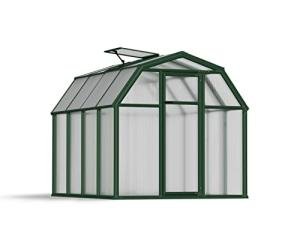
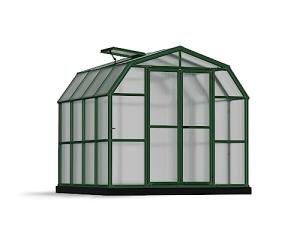
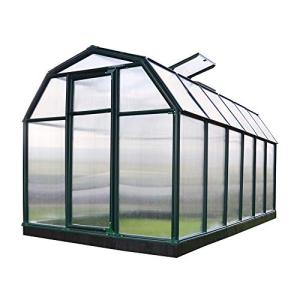
The Grand Gardener 2 breaks from the typical A-frame or lean-to greenhouse shape. Instead, it uses a Dutch barn-style roof — a gambrel profile that curves outward before angling sharply to the peak. This isn't just an aesthetic choice. The barn roof creates substantially more headroom than a traditional peaked design, with a peak height of approximately 7.3 feet and sidewall heights around 61 inches. Tall gardeners can move around comfortably. Hanging baskets, trellises, and overhead shelving all become practical rather than aspirational.
The exterior finish comes in a rich hunter green, which tends to blend more naturally into garden settings than the silver or white frames you'll find on many competing models. It looks less like a utilitarian growing box and more like an intentional part of the landscape.
The Polycarbonate Advantage: Walls, Roof, and Light
The glazing on the Grand Gardener 2 is one of its strongest selling points. The twin-wall version (model HG7216) uses 4mm twin-wall polycarbonate on the roof and 6mm twin-wall polycarbonate on the side panels. Both panel types are virtually unbreakable, 100% UV-protected, and resistant to high impacts and hail.
Here's why that matters in practical terms:
Light diffusion. Twin-wall polycarbonate scatters incoming sunlight rather than transmitting it in focused beams. The result is softer, more even illumination throughout the interior. Plants don't develop hot spots, and you won't see the scorching that sometimes occurs with glass greenhouses during intense afternoon sun. The panels diffuse over 80–90% of incoming light, which promotes more uniform photosynthesis across all your plants — not just the ones lucky enough to sit in a direct beam.
Insulation. The twin-wall construction creates trapped air channels between the inner and outer layers. This acts like a thermal blanket, keeping warmth inside during cooler months and moderating heat buildup in summer. Compared to single-wall polycarbonate or even single-pane glass, the temperature stability is noticeably better. For growers trying to extend their season into early spring or late autumn, that extra insulation can make the difference between thriving seedlings and frozen disappointments.
Durability. Polycarbonate doesn't shatter like glass. It won't crack from hail, and it holds up against the kind of accidental impacts that are inevitable when you're hauling pots, tools, and wheelbarrows in and out of a greenhouse. The panels are also UV-protected against yellowing and degradation, with quality polycarbonate typically lasting 10–15 years before showing significant wear.
Specs and Dimensions at a Glance
The 8 x 16 footprint provides 128 square feet of growing space — enough room for multiple raised beds, shelving along both walls, a potting station, and still adequate aisle space for working comfortably.
| Specification | Detail |
|---|---|
| Overall Dimensions | 202.3" L × 105.1" W × 93.5" H |
| Growing Area | ~128 sq. ft. |
| Peak Height | 7.3 ft. (approximately 93.5") |
| Sidewall Height | 61" |
| Door Opening | 47.5" W × 76.4" H |
| Roof Panels | 4mm Twin-Wall Polycarbonate |
| Side Panels | 6mm Twin-Wall Polycarbonate |
| Frame Material | 100% UV-Protected Extruded Resin |
| Roof Reinforcement | Aluminum Profiles |
| Roof Vents | 3 Adjustable (manual) |
| Doors | Double-door entry |
| Total Weight | ~364 lbs |
| Wind Resistance | Up to 56 mph (90 km/h) |
| Snow Load Rating | 15.4 lbs/ft² (75 kg/m²) |
| Warranty | 7-Year Limited |
| Assembly | Tool-free pin-and-lock system |
Those weather ratings are worth highlighting. A snow load of 15.4 lbs per square foot and wind resistance up to 56 mph mean this greenhouse is engineered for real-world conditions, not just mild California springs. If you're gardening in the Midwest, Northeast, or Pacific Northwest where heavy snow and strong winds are seasonal realities, the Grand Gardener 2 is designed to handle it.
The Frame: Why Resin Outperforms Aluminum (In Some Ways)
Most greenhouses in this price range use aluminum frames. The Grand Gardener 2 goes a different direction with a heavy-duty extruded PVC resin frame reinforced with aluminum profiles on the roof. This is a deliberate engineering choice, not a cost-cutting measure.
Resin offers natural insulating properties that aluminum simply cannot match. Metal frames act as thermal bridges, conducting cold directly through the structure and creating condensation problems. The resin frame on the Grand Gardener 2 breaks that thermal bridge, contributing to better overall insulation and fewer dripping condensation issues on cold mornings.
The resin is also completely weatherproof, UV-resistant, and corrosion-proof. It won't oxidize, peel, or require painting. Maintenance is essentially zero — an occasional wipe-down with soapy water is all it takes to keep it looking new. The frame uses Palram's proprietary pin-and-lock connector system, which creates a clean, rounded finish with no sharp edges. It also makes the assembly process significantly simpler than bolt-together aluminum frames, which we'll get into next.
Assembly: The Good, the Honest, and the Time-Consuming
Let's talk honestly about assembly, because this is where a lot of greenhouse buyers get surprised.
Palram advertises the Grand Gardener 2 as a tool-free DIY installation. That's technically accurate — the pin-and-lock connectors and slide-in roof panels don't require drills, screwdrivers, or saws. All profiles push-fit together, and the roof panels slide into place along tracks. No cutting or drilling is needed.
However, "tool-free" doesn't mean "quick." This is a 364-pound greenhouse shipped in five separate boxes with well over 800 individual parts. Real-world owner reports consistently cite 2–3 full days of assembly time with two people. Some experienced DIYers have managed it faster, but expecting a full weekend commitment is realistic.
The instructions are illustrated step-by-step guides that most reviewers find reasonably clear. The key to a smooth assembly is having a perfectly level foundation ready before you start. The greenhouse should be secured to a concrete pad or heavy timber foundation. An optional base kit is available that adds approximately 12 centimeters (about 5 inches) of headroom while providing additional anchoring stability.
A few honest tips from those who've been through the process: label every piece as you unbox it. Work in calm weather — wind turns polycarbonate panels into sails. And recruit a patient helper, because many steps are genuinely two-person operations.
Ventilation and Climate Control
Proper airflow is make-or-break for greenhouse growing, and the Grand Gardener 2 comes reasonably well-equipped on this front. Three manually adjustable roof vents are included, allowing you to release built-up heat even when the double doors are closed. The double-door entry itself also functions as a ventilation system when propped open during warmer days.
For growers who want more control, Palram offers several compatible accessories. A side louver window provides cross-ventilation at the lower level of the greenhouse, which is critical for preventing stagnant air and fungal problems near the soil line. An automatic roof vent opener can also be added — it uses a wax cylinder mechanism that opens the vent as temperature rises and closes it as temperatures drop, requiring no electricity.
In hot climates or during peak summer, many experienced greenhouse gardeners supplement the built-in ventilation with a small circulation fan or evaporative cooling. The Grand Gardener 2 doesn't include these, but the spacious interior and multiple vent points make aftermarket climate control straightforward to add.
Accessories and Expandability
One of the overlooked strengths of the Rion / Canopia product line is its accessory ecosystem. The Grand Gardener 2 is compatible with a range of add-ons designed to turn the base greenhouse into a fully kitted-out growing station. Available accessories include two-tier staging kits (work benches and shelving), an irrigation system for automated watering, shading kits for mid-summer heat management, trellising for vertical growing, and the aforementioned louver windows and automatic vent openers.
The modular design also means you can theoretically extend the greenhouse length by adding additional sections, though this typically requires purchasing an extension kit and additional foundation work.
Grand Gardener 2 vs. Competing 8×16 Greenhouses
No greenhouse exists in a vacuum. Here's how the Grand Gardener 2 measures up against some of the more popular alternatives in the large polycarbonate greenhouse category.
| Feature | Palram Rion Grand Gardener 2 (8×16) | VEIKOUS 8×16 Polycarbonate | Palram Canopia Glory (8×16) | Exaco Riga IV (8×14) |
|---|---|---|---|---|
| Price Range | ~$1,800–$2,500 | ~$1,200–$1,600 | ~$2,500–$3,200 | ~$4,500–$6,000 |
| Frame Material | UV-Protected Resin + Aluminum Roof | Powder-Coated Aluminum | Heavy-Duty Aluminum | Commercial-Grade Aluminum |
| Roof Panels | 4mm Twin-Wall Polycarbonate | 4mm Twin-Wall Polycarbonate | 10mm Twin-Wall Polycarbonate | 8mm Twin-Wall Polycarbonate |
| Side Panels | 6mm Twin-Wall Polycarbonate | 4mm Twin-Wall Polycarbonate | 6mm Twin-Wall Polycarbonate | 8mm Twin-Wall Polycarbonate |
| Peak Height | ~7.3 ft | ~7.5 ft | ~9 ft | ~7.5 ft |
| Roof Style | Dutch Barn (Gambrel) | Standard Peak | Standard Peak | Gothic Arch |
| Roof Vents | 3 Manual | 2 Manual | 2 Manual | 1 Manual |
| Doors | Double | Double | Sliding | Hinged Single |
| Assembly | Tool-free Pin & Lock | Riveted Slide-in | Bolt-together | Bolt-together |
| Wind Rating | 56 mph | Not Specified | 56 mph | 90+ mph |
| Snow Load | 15.4 lbs/ft² | Not Specified | 15.4 lbs/ft² | 30+ lbs/ft² |
| Warranty | 7 Years | 2 Years | 10 Years | 15 Years |
| Best For | All-around home growers | Budget-conscious buyers | Four-season serious growers | Premium cold-climate setups |
A few key takeaways from this comparison. The Grand Gardener 2 occupies the sweet spot between budget options like the VEIKOUS and premium structures like the Exaco Riga. Its resin frame offers better insulation than the aluminum used by most competitors at this price, and its barn-style roof provides headroom that flat-peaked designs struggle to match. The 7-year warranty is solid for its category, though the Glory and Riga models offer longer coverage for their higher price points.
Where the Grand Gardener 2 gives up ground is in panel thickness. The 4mm roof and 6mm side panels are adequate for most climates, but growers in Zone 4 or colder might benefit from the 8mm or 10mm panels found on pricier models. The wind and snow load ratings are respectable but won't compete with commercial-grade structures.
Who Should Buy the Grand Gardener 2?
This greenhouse makes the most sense for a specific kind of gardener. You're someone who has outgrown smaller hobby greenhouses and wants a genuine walk-in growing space with room for multiple beds, shelving, and a work area. You value low maintenance and don't want to repaint, re-seal, or constantly tighten bolts on an aluminum frame. You need a structure that handles real weather — not just decorative garden ornaments that blow over in the first storm.
It's also an excellent choice for growers who want to start seedlings early, extend their season by several weeks on both ends, and protect sensitive plants like citrus, orchids, or tropical species from winter damage. The insulation provided by the twin-wall panels and resin frame creates a growing environment that stays meaningfully warmer than outdoor ambient temperature, even without supplemental heating.
Who Should Look Elsewhere?
If you garden in an extremely cold climate (USDA Zone 3 or lower) and plan to grow year-round through deep winter, you'll likely need a greenhouse with thicker panels (8mm minimum) and perhaps a heating system. The Grand Gardener 2 can be heated, but its 4mm roof panels won't retain heat as efficiently as thicker alternatives.
If your budget is under $1,500, more affordable options from VEIKOUS, GAOMON, or even Palram's own Hybrid line will get you growing for less — though with compromises in size, insulation, and durability.
And if you're looking for a truly professional-grade structure that can handle extreme snow loads and hurricane-force winds, commercial greenhouse manufacturers like Exaco, Grow More, or Rimol offer sturdier (and significantly more expensive) options.
Final Verdict
The Palram – Canopia Rion Grand Gardener 2 in the 8 x 16 configuration is one of the best-balanced large greenhouses available to home gardeners. It delivers legitimate growing performance — excellent light diffusion, solid insulation, adequate ventilation — in a package that looks attractive, requires essentially no maintenance, and can be assembled without specialized tools or professional help.
It's not the cheapest option on the market, and it's not the most heavy-duty. But for the gardener who wants a real, functional, good-looking greenhouse that will last a decade or more without constant fussing, the Grand Gardener 2 hits a mark that very few competitors manage to reach.
The barn-style roof isn't just charming — it's a practical advantage that translates directly into more usable space and a more comfortable working environment. The resin frame isn't a compromise — it's an insulation advantage. And the tool-free assembly, while time-consuming, means you won't need to hire a contractor or borrow a drill set.
For serious home growers ready to take the next step, the Grand Gardener 2 earns a strong recommendation.