There's a particular kind of stress that comes with planning an outdoor event. You pick a date months in advance, send out invitations, coordinate catering, arrange seating — and then spend the last two weeks obsessively checking weather apps and muttering about barometric pressure. If you've hosted enough backyard weddings, garden birthday parties, or neighborhood gatherings, you know the feeling intimately.
The solution most experienced hosts eventually arrive at is the same: a proper event tent. Not a flimsy pop-up canopy that bends sideways in a mild breeze, and not a rented marquee that costs as much as the catering. Something substantial. Something you own. Something that goes up reliably and comes down when you decide — not when the wind decides for you.
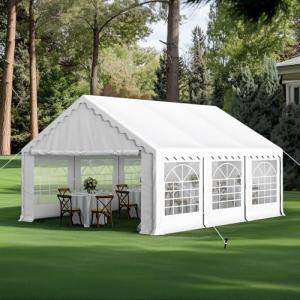
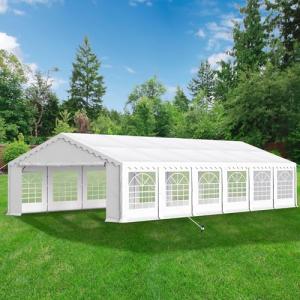
The GARTOO 20' x 40' Heavy Duty Party Tent has been making a name for itself in exactly this space. Sold on Amazon and shipping from COVERONICS INC, it targets the serious backyard entertainer, the small-venue operator, and the family that hosts one landmark event per year and wants it done right. At 800 square feet of covered space, it's one of the most spacious consumer-grade event tents on the market. But size alone doesn't make a tent. Let's look at what this thing actually delivers.
Who Is This Tent Actually For?
Before diving into specs, it's worth asking the honest question: who actually needs a 20' x 40' tent?
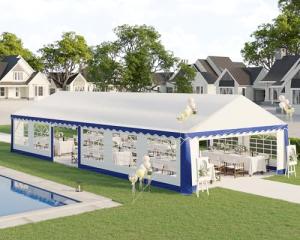
The short answer is more people than you'd think. A tent this size can comfortably seat 50 people for a sit-down dinner and accommodate considerably more for a cocktail-style gathering or buffet setup. That covers most milestone birthday parties, anniversary celebrations, backyard weddings for close friends and family, graduation parties, and reunions. It also works well for community events, farmer's market stalls, school fundraisers, and small commercial operations that need occasional covered outdoor space.
GARTOO notes that their products are suitable for both outdoor and indoor use, providing space for customers to enjoy leisure time with friends and family. That indoor versatility is worth noting — a tent this size can work in a large warehouse, barn, or convention-style space where you want to create defined zones without permanent infrastructure.
If you're hosting more than 100 seated guests, you'll want to look at commercial-grade pole tents or multi-bay frame tent setups. But for the vast majority of private events and semi-commercial uses, the 20x40 footprint is the sweet spot between "large enough to matter" and "manageable to store and set up."
The Frame: Galvanized Steel That Actually Holds Up
The backbone of any event tent is its frame, and this is where the GARTOO distinguishes itself from the cheaper canopy options crowding the market.
The outdoor canopy event tent is made of a galvanised heavy-duty frame, and the galvanization craftsmanship makes it more rust resistant and more durable. This matters a great deal for anyone who plans to use the tent more than once or twice. Ungalvanized steel frames rust quickly, especially when stored in garages or sheds where temperature swings cause condensation. A rusted frame not only looks bad — it compromises structural integrity and eventually fails at the joints.
The galvanization process coats the steel in a protective zinc layer that resists corrosion even in humid conditions. For a product you're going to pack away between uses and potentially store through winter, this is not a luxury feature — it's a baseline requirement. The GARTOO delivers on it.
The canopy wedding tent includes Strong Grip, Strong Rope and Sand Bags to ensure the stability of the party tent. The metal stakes ensure that the tent is secured to the ground deeply. This multi-layered anchoring system — stakes in the ground supplemented by sand bag weights at the legs — is a thoughtful approach to stability. On soft ground like grass or packed earth, the stakes do the primary work. On hard surfaces like patios, decks, or asphalt where staking isn't possible, the sand bags take over. Having both options included in the package means you're not buying a tent and then immediately shopping for accessories before you can safely use it.
800 Square Feet of Space: What That Actually Looks Like
Numbers on paper can be deceiving. Eight hundred square feet sounds like a lot until you start populating it with tables, chairs, a buffet station, and a few dozen guests who all have opinions about personal space.
Here's a practical breakdown of what 20' x 40' allows:
Seated dinner configuration: Round tables seating 8 guests each require roughly 64 square feet per table including chair clearance. You can fit 8–10 tables comfortably, covering 64–80 guests with breathing room for a dance floor or head table arrangement.
Cocktail/reception style: Remove fixed seating and you can accommodate 100+ guests with high-top tables scattered throughout. Add a bar setup at one end and a small stage or DJ area at the other and you've still got functional flow space.
Ceremony seating: Row seating is more efficient. With chairs placed in theater-style rows with a center aisle, 80–100 guests fit without feeling cramped.
Vendor or market use: Eight 6-foot vendor tables with adequate aisle space between them, plus room for foot traffic. Ideal for craft fairs, pop-up markets, or multi-vendor events.
The wedding canopy tent can hold up to an estimated 50 people for dining or party. That's the conservative manufacturer estimate for seated dining — a smart figure that accounts for realistic furniture layouts and movement. For standing or cocktail events, the actual capacity is meaningfully higher.
The Sidewalls: More Versatile Than They Look
One of the defining features of this tent — and one of the most practically significant — is the removable sidewall system. This isn't a detail to gloss over.
Many party tents come with sidewalls that are either permanently attached or a complete hassle to install and remove. The GARTOO takes a more considered approach.
Additional zippers have also been added to the sidewalls to make the sidewalls resemble a roll-up door, keeping the outdoor heavy-duty canopy party tent well-ventilated and providing plenty of airflow, as well as for easy entry and exit during outdoor activities.
This roll-up door functionality changes the practical calculus significantly. On a clear, mild evening, roll the sidewalls up and you have an open-air pavilion with a roof — perfect for backyard parties where guests want to move between the tent and the surrounding garden or lawn. When the weather turns or the evening gets cool, roll the walls down and zip them shut, and you have an enclosed shelter. The ability to transition between these configurations without disassembling anything is genuinely useful.
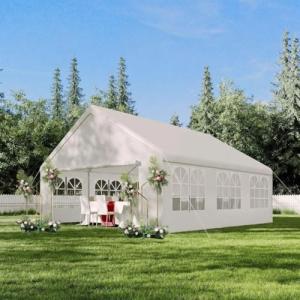
The sidewalls also serve privacy and aesthetic functions. White fabric walls create a clean, neutral backdrop that photographs well and feels more intentional than a bare-bones canopy. For weddings and milestone events where atmosphere matters, this is not a trivial consideration.
Setup: What to Actually Expect
The product description promises tool-free assembly, which sounds great but deserves scrutiny. The honest reality with any 20x40 tent is that setup is a multi-person job — not because the individual steps are technically difficult, but because of the sheer scale of the structure.
This waterproof outdoor wedding gazebo does not require additional patio tent tools to install. It is easy to assemble — you just need to keep the frame stable while assembling the wedding tent steel tube and cover.
The key phrase is "keep the frame stable while assembling." For a tent this size, that means having at least two people and ideally three or four. One person can lay out all the poles and organize hardware; actually erecting the frame and covering it with the canopy top is a coordination task that benefits from extra hands at the corners.
Experienced users report that first-time setup takes 60–90 minutes with two people who have read the instructions thoroughly. Subsequent setups, once you've learned the assembly logic and organized your hardware, typically run 30–45 minutes. That's a reasonable time investment for a structure of this scale.
A few practical setup tips worth knowing:
Label your poles after the first assembly. The tubing sections can look similar, and having them labeled by position significantly speeds up future setups.
Lay the cover out fully before raising the frame. It's much easier to orient the canopy correctly when it's flat on the ground than once the frame is partially erect.
Stake before tensioning. Get stakes in the ground at all corners before applying tension to the cover — this prevents the frame from walking during setup.
Sandbag placement matters. Distribute the four included sand bags to the legs that will take the most wind load, which is typically the windward side.
Weather Performance and Honest Limitations
Every tent manufacturer walks a fine line between marketing durability and acknowledging real-world limitations, and GARTOO is appropriately transparent here.
Party tents should not be left up for long periods of time in extreme weather such as heavy rain, strong winds or storms as they can blow over. Please note that when a storm comes, the tent should be stowed away to prevent it from being blown away. In winter, you need to remove the snow from the tarp in time to prevent the tent from collapsing.
This is honest and important information. A party tent of this style — what the industry calls a "frame tent" or "canopy tent" — is not a four-season permanent structure. It's event infrastructure. It goes up for an event, performs reliably in normal outdoor conditions including light rain and moderate breezes, and comes down when the event ends or when serious weather is forecast.
The waterproofing on the canopy top handles standard rain without issue. The galvanized frame and anchoring system provide adequate stability in typical outdoor conditions. What the tent is not designed to handle: sustained high winds above 30–40 mph, heavy snow accumulation, or being left up unattended for weeks at a time.
Understanding this honestly — rather than expecting the tent to perform like a permanent structure — leads to consistently good experiences. Users who treat it as serious event infrastructure get reliable, long-lasting performance. Users who leave it up through a windstorm because they didn't want to take it down get disappointed.
The Sand Bag Advantage: A Smarter Anchoring Solution
The inclusion of four sand bags in the package deserves special mention because it addresses a genuine problem with party tent ownership: not all surfaces can be staked.
Concrete patios, wooden decks, paved driveways, and asphalt surfaces all present the same challenge — you can't drive stakes into them. For users without a large lawn, this used to mean either buying supplemental weights or limiting where the tent could go. GARTOO solves this by including sand bags as a standard part of the package.
The sand bags attach to the tent legs and, once filled, provide substantial anchoring force. They work in combination with stakes on soft ground for maximum stability, or independently on hard surfaces where staking isn't possible.
For anyone planning events on a patio, driveway, or parking area, this isn't a convenience — it's what makes the tent usable at all in those locations.
Comparison: GARTOO 20x40 vs. The Competition
The 20x40 party tent market has become surprisingly competitive. Here's how the GARTOO stacks up against the most commonly compared alternatives:
| Feature | GARTOO 20x40 | COBIZI 20x40 | Outsunny 19.5x39 | YITAHOME 20x40 | Quictent 20x40 |
|---|---|---|---|---|---|
| Frame Material | Galvanized steel | Galvanized steel | Steel | Galvanized steel | Steel |
| Sidewalls | Removable, zippered | 8 removable sidewalls | Removable w/ windows | Removable | Removable |
| Anchoring Included | 4 sand bags + stakes | 4 built-in sandbags | Stakes | 4 storage bags | Storage bags |
| Ventilation | Zippered roll-up walls | Multiple panels | Windows in sidewalls | Standard | Standard |
| Assembly | Tool-free | Tool-free | Tool-free | Tool-free | Tool-free |
| Best For | Weddings, events, versatile use | Commercial/heavy use | Parties with window views | Budget-conscious buyers | Frequent renters/resellers |
| Approx. Capacity (seated) | ~50 dining / 80+ cocktail | ~50–80 | ~50–80 | ~50 | ~50 |
| Size Availability | 6 sizes | Multiple | Limited | Multiple | Multiple |
| Carry Bags Included | Yes | 7 bags | Carry bags | 4 storage bags | Storage bags |
A few notes on this comparison:
The COBIZI is a strong competitor with more sidewall panels (8 vs. the GARTOO's standard configuration), making it slightly more flexible for enclosure configurations. It tends to run at a higher price point.
The Outsunny at 19.5' x 39' is slightly smaller and adds windows to the sidewalls, which improves natural light and ventilation for enclosed use — a genuine plus for daytime events.
YITAHOME is often the first option shoppers find and is competitively priced, though reviews suggest the GARTOO's galvanized frame holds up better over time.
Quictent has a strong reputation among tent rental businesses and frequent-use operators because of consistent build quality, but tends to be priced accordingly.
The GARTOO sits in a favorable position: galvanized frame construction, sand bag anchoring, zippered ventilation, and size flexibility at a price point that makes it accessible for private buyers, not just commercial operators.
Multiple Sizes: Scaling Up or Down
One practical advantage of the GARTOO line is the availability of six different size options. The party tent has six different sizes available. For buyers who need a smaller footprint — a 13x20 for a small patio gathering, or a 13x26 for a medium event — the same build quality and design language applies across the range.
This matters for storage as much as anything else. A 20x40 tent packs down into several carrier bags, but it still represents a meaningful storage commitment. Knowing you can step down to a 10x30 or 13x26 for smaller gatherings without buying from a completely different brand — and therefore learning a different assembly system — is a genuine convenience.
Real-World Use Cases: Beyond the Obvious
The typical buyer is planning a wedding or birthday party, but the use cases for a 20x40 tent extend further than the marketing copy suggests.
Backyard concerts and performances. The 800 square foot footprint is sufficient for a small stage at one end with audience space in front. The white canopy top reflects and diffuses sound in a way that adds ambient warmth rather than echo.
Outdoor classroom or workshop space. With the sidewalls down, the tent creates a defined, weather-protected workspace for craft workshops, outdoor cooking classes, yoga retreats, or art installations. The white interior is neutral and bright.
Temporary carport. The GARTOO line explicitly markets some sizes as carport alternatives. For storing vehicles during construction or renovation, protecting equipment from weather, or creating a covered loading/unloading zone, a tent this size works as a practical utilitarian shelter.
Pop-up retail. For seasonal businesses, craft fair vendors, or brands doing experiential activations, a 20x40 branded tent creates a significant footprint that's repeatable and portable.
Disaster preparedness. This sounds unusual until it isn't. In areas prone to flooding, storm damage, or other emergencies, having a large, deployable shelter stored in a garage is genuinely useful. Neighborhood mutual aid organizations increasingly maintain event tents precisely for this reason.
What to Know Before You Order
A few practical notes for prospective buyers that aren't always obvious from product listings:
Shipping comes in multiple boxes. A tent this size ships as several separate packages. Plan for delivery of multiple heavy boxes and make sure someone is home or a safe delivery location is arranged.
You'll need to supply the sand. The sand bags are included; the sand is not. Factor in purchasing 50–80 lbs of play sand or construction sand for the four bags. This is standard practice across all tent brands.
Carry bags are included. Organized storage is important for tent longevity — tangled poles and folded incorrectly stored canopy fabric wear faster. The included carry bags encourage proper storage habits.
Read the instructions before your first event. This sounds obvious but is frequently skipped. The first time you assemble a tent this size should not be the day of the event. A practice assembly two weeks before gives you time to identify any missing hardware and learn the assembly sequence without time pressure.
Seasonal storage matters. Before storing for the season, make sure the canopy fabric is completely dry. Mold and mildew in folded wet fabric is the single most common cause of canopy degradation.
A Solid Investment for Serious Entertainers
The GARTOO 20' x 40' Heavy Duty Party Tent earns its place in a crowded market by getting the fundamentals right. The galvanized frame is built for repeated use over multiple seasons. The sand bag and stake anchoring system gives you genuine flexibility across surface types. The zippered sidewalls provide ventilation control that cheaper tents simply don't offer. And the 800 square feet of covered space is generous enough to handle events that actually matter.
It's not a commercial-grade tent — it won't replace a professionally installed marquee for a 200-person wedding, and it shouldn't be left up through a storm. But for the serious backyard entertainer, the small venue operator, or the family that hosts one or two landmark events per year, it represents excellent value and genuine capability.
The question to ask yourself isn't whether this is the most impressive tent on the market. It's whether it does what you need, lasts long enough to justify the investment, and sets up reliably when the day comes. On all three counts, the GARTOO 20x40 delivers.
Ready to buy? Check current pricing and availability for the GARTOO 20' x 40' Heavy Duty Party Tent on Amazon.