The Material Question: Why Vinyl Composite Changes the Game
The Carolina is crafted from BPA/phthalate-free embossed PVC — a formulation that's meaningfully different from generic outdoor plastic. The embossing process presses a wood-grain texture directly into the surface of the vinyl during manufacturing, which means the grain isn't painted on and won't peel, flake, or fade the way a painted finish eventually does. What you're left with is a material that catches light the way real timber does, reads as wood from any normal viewing distance, and requires none of the upkeep that wood demands.
Customers consistently note that the color for the main structural pieces is very good and very wood-like in appearance, and that once assembled and installed, it looks genuinely attractive in a real yard — not like a plastic imitation, but like a considered design choice.
The BPA and phthalate-free certification is more than a marketing badge. It signals that the compound used is formulated without the softening plasticizers that have raised health and environmental concerns in older PVC products. For a structure that will live in your garden through seasons of rain, sun, and fluctuating humidity — and may well host edible climbing plants like beans or cucumbers — that distinction matters.
Dimensions That Actually Work: The 57 x 88 Inch Proportions Explained
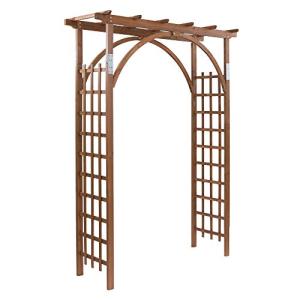
Arbors fail for one of two reasons: they're too small to feel like a real architectural element, or they're so large they overwhelm the space. The Carolina's proportions — 57 inches wide, 24 inches deep, and 87.75 inches tall — sit in a sweet spot that most residential gardens can accommodate without either problem.
The opening can be adjusted to span up to 50 inches, which is wide enough to feel genuinely welcoming as a walkway entrance and accommodating enough for a wheelbarrow, garden cart, or two people walking side by side. The 88-inch height means even tall adults pass beneath it comfortably, and the overhead clearance doesn't feel oppressive.
The 24-inch depth — the front-to-back measurement — is where a lot of garden arbors cut corners, resulting in a structure that looks flat and unconvincing from the side. The Carolina's depth gives it genuine three-dimensionality; it reads like architecture, not decoration. And the posts, measuring 2 inches by 3.5 inches, are substantial enough to convey solidity when you grip them, which happens more than you'd think.
At 55 pounds assembled weight, it has enough mass to feel like a permanent fixture without requiring heavy equipment or a second person for the actual installation.
The Lattice Detail: More Than Decorative
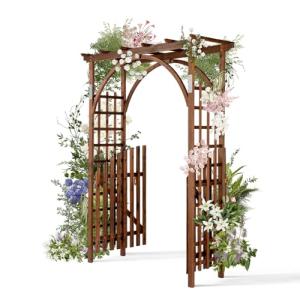
The lattice panels running along the sides of the Carolina are doing double duty. Aesthetically, they break up what could otherwise be flat planes of brown vinyl into something with rhythm and shadow — the kind of visual texture that makes a garden structure look like it belongs in a thoughtfully designed space rather than a big-box parking lot display.
Functionally, the lattice detail supports climbing plants and flowers, and it does so well. The grid spacing is generous enough that most climbing varieties — roses, clematis, jasmine, sweet peas, morning glories, passionflower — can grab on without assistance, and tight enough to provide real support once they start doing so. Within a single growing season, the Carolina can disappear almost entirely behind a wall of foliage and bloom, at which point it stops being a garden accessory and starts being a garden feature.
One customer transplanted a vine on each end and wove it into the lattice, and reported the final result was very attractive. That's the kind of integration that separates a structure worth buying from one that just takes up space.
Assembly and Installation: A Realistic Account
Vita estimates assembly at one person, three to four hours, with a cordless drill, level, short ladder or stool, and shovel listed as required tools. For permanent installation, cement is also recommended. That's a realistic estimate for someone who reads instructions carefully — not a rushed hour, but also not a weekend project.
The assembly process is largely a matter of connecting pre-formed components via locking tabs, which snap together with satisfying firmness. The instruction manual is available in English and French, and the diagrams are clear enough that you won't need to rely on guesswork. The arbor includes anchoring stakes for easy in-ground installation, which work well in standard soil. For a more permanent setup — particularly if you're in a region with seasonal wind or are mounting it at the edge of a deck — Vita recommends slipping the legs over pressure-treated 2x4s driven into the ground, which significantly improves rigidity.
One practical note worth knowing: a locking tab on arbor spindles can be released with a flat-head screwdriver and light back-and-forth pressure if you need to correct an assembly error — a small but useful detail that saves frustration.
The 10-Year Warranty: What It Covers and Why It Matters
The Carolina comes with a 10-year limited warranty against manufacturing defects, valid for purchases through Vita or authorized retailers. In the context of outdoor garden structures — where the competition often offers one year, or nothing at all — a decade-long warranty is a genuine differentiator.
It reflects something real about the material. Embossed PVC doesn't rot, splinter, or succumb to insect damage. It doesn't require annual sealing, staining, or painting. It won't cup or warp through freeze-thaw cycles. The maintenance routine is essentially limited to an occasional rinse with a garden hose. For anyone who has ever rebuilt a wooden arbor after five years of weathering, that combination of longevity and minimal care is not a trivial selling point.
How the Carolina Compares: Vinyl Arbor vs. the Alternatives
Choosing an arbor means navigating a range of materials, price points, and durability trade-offs. Here's how the Carolina holds up across the most relevant comparisons:
| Feature | Vita Carolina (Vinyl) | Cedar Wood Arbor | Metal/Iron Arbor | Pressure-Treated Pine |
|---|---|---|---|---|
| Material | Embossed BPA-free PVC | FSC Cedar | Powder-coated steel | Treated pine |
| Typical Height | 88 inches | 87–90 inches | 84–90 inches | 84–96 inches |
| Maintenance | Rinse only | Annual stain/seal | Occasional rust treatment | Annual sealing required |
| Rot/Insect Resistance | Fully resistant | Natural resistance | N/A | Chemical treatment only |
| Warranty | 10 years (manufacturing defects) | 1 year | 1–2 years | Varies |
| Weight | 55 lbs | 40–70 lbs | 20–40 lbs | 50–80 lbs |
| Assembly Time | 3–4 hours | 3–5 hours | 1–2 hours | 4–6 hours |
| Wood-Grain Appearance | Embossed texture | Natural | None | Natural |
| Price Range | ~$300–$430 | ~$200–$400 | ~$80–$300 | ~$150–$350 |
| Longevity | 15–20+ years | 7–15 years | 10–20 years | 5–12 years |
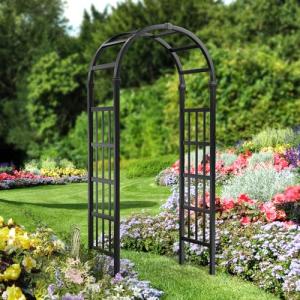
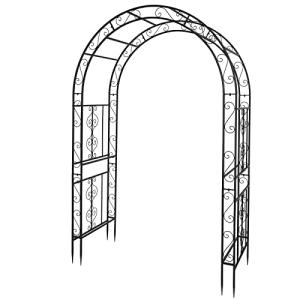
The comparison reveals where the Carolina earns its price. Against a cedar alternative, it matches aesthetics closely while dramatically reducing upkeep. Against metal arbors, it wins on warmth and visual character — iron and steel garden arches can look striking in a formal context, but they lack the organic quality that makes an arbor feel like it grew alongside the garden. Against pressure-treated pine, the vinyl wins decisively on longevity: treated lumber still splinters, still requires maintenance, and still eventually fails.
Where It Works Best: Practical Placement Ideas
The Carolina is versatile enough to work in several contexts, but it earns its keep most decisively in a few specific scenarios.
As a garden entrance, it's close to ideal — wide enough to feel welcoming, tall enough to feel like a threshold, and proportioned to look purposeful rather than decorative. Frame it with a gravel path, flank it with low hedging, and you have an entrance worth arriving through.
As a pathway accent, particularly in a longer garden walk, the Carolina can be installed in pairs or series with climbing plants linking them into a green tunnel over time. Wisteria and climbing roses are the classic choices; for faster results, annual climbers like black-eyed Susan vine or sweet peas will cover the lattice within a single season.
As a focal point at the rear of a border, with the lattice panels against a fence or wall, it creates vertical interest and a sense of depth that flat planting beds can rarely achieve alone.
It's also notably well-suited for deck-to-garden transitions — that slightly awkward zone where decking meets lawn or planting bed. Several owners have successfully adapted the installation to accommodate the height differential between deck surface and ground, creating a seamless visual connection between the two spaces.
What You're Actually Buying
The Vita Carolina 57"W x 88"H Composite Vinyl Arbor is a mature product from a manufacturer that clearly understands what gardeners actually want from an outdoor structure: something that looks genuinely good, holds up without constant attention, installs without professional help, and earns back its cost in years of reliable performance.
At $429.99 with free shipping across the continental US, it sits at a price point that reflects quality without demanding a landscaping budget. The 10-year warranty backs that up. And for anyone who has watched a wooden arbor deteriorate over five or six seasons and faced the prospect of rebuilding or replacing it — that warranty, combined with a material that simply doesn't rot — reframes the purchase as an investment rather than an expense.
The Carolina is not a dramatic piece of garden architecture. It won't stop visitors in their tracks the way a custom pergola or a hand-built gate might. What it will do, reliably and year after year, is make whatever corner of the garden it occupies look more intentional, more designed, and more beautiful — especially once the climbing plants take hold and the structure begins to disappear into exactly the kind of living feature every garden deserves.
Product available on Amazon and directly from Vita. Free shipping across the continental United States.