Who Is This Hutch Actually For?
Before diving into materials and measurements, it's worth addressing the obvious question: who actually needs a hutch at this price point and size?
The PawHut 54" is marketed primarily for rabbits, but the Amazon listing explicitly mentions chickens and ducks as suitable inhabitants too. Real-world buyers have used it for guinea pigs, quail (reportedly 6–10 per level works well), and various other small animals. That flexibility is a genuine selling point. If you're a household with more than one species of small pet, or if you anticipate expanding your little backyard flock, this hutch doesn't force you into a single-species commitment.
The design is described as suitable for two rabbits, and that's a reasonable baseline. For dwarf breeds or guinea pigs, you could comfortably house three or four animals depending on temperament. For larger rabbit breeds like Flemish Giants or New Zealands, one per level is more realistic.
First Impressions: Build Quality and Materials
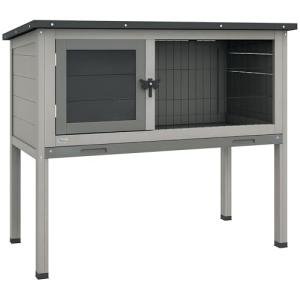
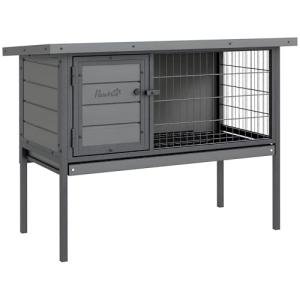
The hutch is constructed from fir wood and metal wire, and the brown variant features a treated wood finish that gives it a warm, cabin-like aesthetic. This isn't the cheap pine you find on discount hutches that splinters within a few months and turns gray-green from moisture. Fir is a denser, more resin-rich wood that holds up considerably better against humidity, temperature swings, and the inevitable chewing that comes with rabbit ownership.
The treated wood finish contributes to a stable structure that complements backyard décor — and honestly, that's not just marketing language. The brown color reads more like furniture than like a farm implement, which matters if the hutch is going on a patio or deck where aesthetics are part of the consideration. It's a hutch that guests won't wince at.
The metal wire mesh is welded rather than twisted, which is the right call for small animal housing. Twisted wire mesh develops weak points over time and can leave sharp edges that injure curious animals. The gauge is solid enough to deter most predators, though it's worth noting that no hutch should be considered a substitute for proper predator-proofing if you're housing animals in a high-risk outdoor area.
The roof uses a composite asphalt shingle material that protects animals from rain and provides shade on sunny days. This is a detail that separates quality hutches from cheap ones. Plastic or thin wood roofing warps quickly and leaks. Asphalt composite roofing behaves much like actual roofing material — it sheds water effectively and doesn't degrade from UV exposure at the same rate as lesser materials.
Dimensions and Space: The Honest Breakdown
Overall dimensions come in at 53.75" L x 19.75" W x 36.5" H, with inner cage space of 48" L x 16.5" W x 14.25" H per level. The legs raise the hutch approximately 4 inches off the ground, which helps with airflow and prevents ground moisture from wicking into the wood.
Let's be real about what those numbers mean in practice. The inner height of 14.25 inches per level is adequate for most rabbit breeds in a resting position but doesn't allow for much vertical exploration. This is a hutch, not an enclosure — the expectation is that animals will have supervised time outside of it daily. Anyone who tells you a rabbit can live full-time in a structure this size without daily exercise time is not giving you good advice, regardless of what the product listing says.
The 48-inch internal length per level is legitimately generous. Rabbits need to be able to stretch out completely and take a few hops from one end to the other, and this hutch accommodates that for most medium breeds. Side by side, you're looking at about the interior footprint of a standard bathtub per level — cramped by free-range standards, but perfectly reasonable for a sleeping and feeding space.
The Two-Story Design: More Than a Marketing Angle
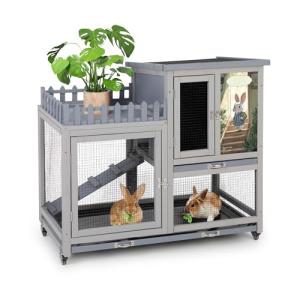
The upper level is designed as a resting space while the lower level provides a more open area for play. This distinction is built into the physical design, not just a suggestion. The upper level is more enclosed with solid wood panels providing three sides of privacy. The lower level features more open wire mesh panels, letting in more light and air while giving animals a view of their surroundings.
This mirrors the natural behavioral preferences of rabbits remarkably well. Rabbits are crepuscular animals that feel safer when they have access to a sheltered hiding spot. The enclosed upper level serves as that burrow-like space where an anxious rabbit can retreat and decompress. Meanwhile, the lower level's openness encourages active behavior during waking hours.
For multi-animal households, the two floors provide natural territory separation. One reviewer recommended housing one bunny per level and ensuring regular roaming time outside the hutch. That's sound advice. Two rabbits that don't fully bond can share this hutch without constant conflict if each has a "home floor" to retreat to.
The Door System: Four Access Points That Make Life Easier
The hutch includes four doors total — two easy-access doors per cage level. Each level has a wire mesh door and a solid wood door, giving you two ways to interact with the animals and access the interior.
This dual-door system is genuinely clever. The wire doors allow you to check on animals, top up water bottles, or drop in hay without fully opening the hutch and risking an escape. The wood panel doors offer full interior access for deep cleaning, bedding changes, or catching animals for health checks. The lockable latches on both door types are secure enough to prevent determined animals from pushing them open, which is not something you can say about every hutch in this price range.
Four total access points across two levels means less contorting and reaching. Anyone who has wrestled with a one-door cage while trying to change bedding with one hand and prevent an escape with the other will immediately appreciate this setup.
Cleaning: The Pull-Out Tray System
This is where most hutch designs either earn trust or lose it completely. Cleaning is the daily or weekly reality of small animal ownership, and if the cleaning system is poorly designed, the whole hutch becomes a burden.
The PawHut 54" includes removable floor trays on each level for easy cleaning and feeding access. The bottom tray measures approximately 47.75" L x 16.5" H and slides out from the front of the hutch without requiring you to open doors or lift animals.
The no-leak tray design prevents waste from seeping through the flooring, which is the biggest sanitation concern in any multi-level hutch. When a two-story hutch lacks a proper tray system, waste from the upper level falls through to contaminate the lower level, creating hygiene problems and unpleasant odors that are very difficult to remediate.
The pull-out trays here handle that problem cleanly. Slide out, dump, rinse, replace. Some users noted the pullout tray as the main area of concern, specifically that it requires careful handling to avoid spilling. This is worth noting — the trays don't have high sides, so a confident pulling motion is better than a tentative one. Pull slowly and you risk tipping; pull with intention and the tray comes out cleanly.
Weather Resistance: Outdoor Durability in Practice
The hutch is made of durable fir wood combined with a water-resistant composite asphalt roof. That combination handles the two main threats to outdoor wooden structures: moisture from above and ground-level humidity.
The asphalt shingle roof is the hero feature here. It's not a decorative topping — it's functional roofing that channels water away from the structure the same way a house roof does. Rain hits the shingles, runs toward the overhang, and drips off the edge rather than pooling on a flat surface or soaking into wood grain.
The fir wood body benefits from the factory treatment, but additional weatherproofing is strongly recommended if the hutch will live outdoors year-round. A coat of exterior wood sealant or pet-safe paint applied annually adds years to the structure's life, particularly on the floor panels and legs, which see the most moisture exposure. This is not a criticism of the hutch — it's standard maintenance practice for any wooden outdoor structure.
The hutch is suitable for both outdoor and indoor use, and the design transitions between environments without issues. Indoors, the natural wood finish reads as furniture-adjacent. Outdoors, the brown color blends with garden and backyard settings.
Assembly: What to Realistically Expect
Most buyers report that assembly is straightforward and the hutch goes together without major difficulty. One reviewer noted assembling it solo at 68 years old with no assistance. That said, a second set of hands makes the process faster and reduces the chance of misaligned panels during the panel-joining steps.
One assembler mentioned that the screws don't set ideally by hand and recommended using a drill carefully to avoid splitting the wood. This is good advice. Pre-drilling pilot holes before driving screws into fir is always the safer approach — it takes an extra few minutes but prevents the splitting and stripping that causes frustration down the line.
The instructions are visual rather than text-heavy, which works for most steps but can cause confusion at a couple of specific joints. Some users noted instructions can be unclear at certain points, so budgeting 90 minutes to two hours for a careful first assembly is realistic. This is not a 20-minute snap-together product, but the finished result is proportionally more solid than anything in that category.
No wheels are included, which some buyers would appreciate. One owner added aftermarket wheels to make repositioning easier. If mobility is important for your setup, locking furniture casters rated for 40+ lbs per wheel are an inexpensive addition that transforms the hutch into something far easier to move for cleaning or repositioning.
Versatility: Beyond Rabbits
One of the genuinely pleasant surprises of researching this hutch is how creatively people use it. Reviewers have successfully housed quail at 6–10 birds per level, and guinea pig owners have used it to separate bonded pairs that needed temporary housing. The design's open wire mesh lower level is particularly well-suited to poultry like bantam chickens, quail, and young ducks, who appreciate the ventilation and ground-level visibility.
For chicken keepers running a small backyard flock, this hutch works as a grow-out pen for chicks transitioning from a brooder or as a quarantine space for new birds before integration into a main coop. The lockable doors prevent predator entry at night, and the waterproof roof handles rain without intervention.
For duck keepers, the lower level works reasonably well for a pair of call ducks or bantam ducks, though standard Pekin or Khaki Campbell ducks would outgrow it quickly. The no-leak tray is particularly valuable with ducks, who are enthusiastic and messy water users.
Comparison: How Does It Stack Up Against Competitors?
Here's an honest comparison of the PawHut 54" 2-Story against comparable hutches in the same general price bracket:
| Feature | PawHut 54" 2-Story | Aivituvin 36" 2-Story | Narkula 41" 2-Floor | PawHut 48" 2-Story (Smaller Version) |
|---|---|---|---|---|
| Overall Dimensions | 53.75" x 19.75" x 36.5" | 36" x 21" x 43" | 41.3" x 17.3" x 41.3" | 48" x 19.5" x 40" |
| Levels | 2 | 2 | 2 | 2 |
| Material | Fir wood + metal wire | Fir wood + metal wire | Wood + metal wire | Fir wood + metal wire |
| Roof Type | Asphalt composite shingle | Asphalt shingle | Wood/asphalt | Asphalt composite shingle |
| Pull-Out Trays | Yes (no-leak) | Yes (2 trays) | Yes (deeper trays) | Yes |
| Wheels | No (add-on required) | Yes (included) | Yes (included) | No |
| Lockable Doors | Yes (4 doors) | Yes | Yes (4 doors) | Yes |
| Ramp Included | No | Yes | Yes | Yes |
| Best For | Rabbits, quail, poultry | Rabbits, guinea pigs | Guinea pigs, rabbits | Rabbits, chickens |
| Indoor/Outdoor | Both | Both | Both | Both |
| Approximate Price | Mid-range | Mid-range | Mid-range | Slightly lower |
The PawHut 54" wins on pure interior floor space compared to most competitors in its price range. The Narkula option comes with wheels and deeper trays out of the box — a real advantage if cleaning convenience is a top priority. The Aivituvin includes a ramp between levels, which matters for animals you want to move freely between floors without manual transfer.
Where the PawHut 54" genuinely leads is the footprint-to-space ratio: nearly 54 inches of length in a hutch that doesn't require a dedicated corner of a room or a large shed footprint. That makes it the strongest choice for patio or deck placement where space is moderate but not unlimited.
The Case For and Against
Every purchase deserves a clear-eyed summary of the tradeoffs, and this hutch is no different.
The case for buying it is strong if you have one or two rabbits, a small poultry project, or a multi-species small animal setup. The materials are genuinely above average for this price range, the asphalt roof is a durable upgrade over plastic or plain wood alternatives, the four-door access system makes daily care significantly less cumbersome, and the no-leak tray system handles waste hygienically without excessive effort.
The case against buying it is narrower but real. If your rabbits are large breeds and you're not committed to daily free-roam time, this hutch won't give them enough living space long-term. If you need built-in wheels and a ramp out of the box, competitors offer those at comparable prices. And if you're looking for a completely tool-free setup, the assembly process requires a drill for the best results.
Final Verdict
The PawHut 54" 2-Story Large Rabbit Hutch in brown is one of the more thoughtfully designed hutches available at its price point. It doesn't cut corners where it matters — the roof is genuinely weatherproof, the wood is quality fir, the tray system is functional, and the multi-door layout reflects real understanding of how people interact with small animal housing on a daily basis.
It's not a "set it and forget it" solution. It needs regular cleaning, occasional resealing, and a committed owner who treats it as a home base rather than a full-time enclosure. Managed that way, it will last several seasons without significant degradation and provide a comfortable, secure space for rabbits, chickens, ducks, quail, or guinea pigs who also get regular time outside of it.
For anyone taking small animal ownership seriously — which is the only way it deserves to be taken — this is a hutch worth the investment.
👉 Check current price and availability on Amazon