There's a particular kind of anxiety that creeps in when you're planning an outdoor event. You've booked the caterer, finalized the guest list, and designed the centerpieces — and then you look at the weather forecast and realize you have absolutely no control over any of it. A quality party tent isn't just a nice-to-have. It's the difference between a memorable celebration and a disaster managed with garbage bags and optimism.
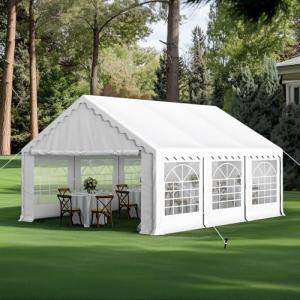
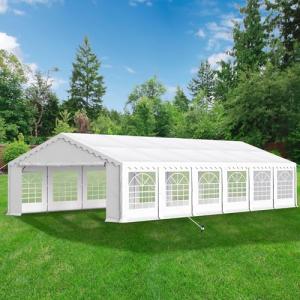
The ActiveTrail 20x20 ft Heavy Duty Party Tent has entered a crowded market with a confident proposition: a white commercial-grade shelter with a waterproof roof, removable sidewalls, and the kind of structural integrity that lets you stop worrying about the sky and start focusing on the party. At 400 square feet of covered space, it's substantial enough for a real wedding reception, a backyard festival, a graduation celebration, or a trade event — and it breaks down for storage when the season ends.
This guide covers everything you need to know before you buy, including how it stacks up against the competition.
What You Actually Get: Size, Footprint, and Capacity
Let's start with the numbers, because they tell the most important part of the story.
A 20x20-foot tent means 400 square feet of protected floor space. That's not a modest pop-up canopy — that's a serious event structure. To put it in practical terms, a 20x20 tent can comfortably seat between 30 and 40 guests at round tables with room for a small dance floor or buffet station on one side. Push that to standing room or bench seating, and you're looking at 50 to 65 people under the same roof without things feeling claustrophobic.
The peak height on a tent of this class typically hits around 127 inches — roughly 10.5 feet at the apex — while the eave height (the usable headroom at the edges) sits at approximately 79 inches, or about six and a half feet. That's tall enough for guests to move freely, for hanging string lights or lanterns, and for catering staff to carry trays without hunching over.
For backyard use, you'll want to verify your available footprint before purchasing. The 20x20 frame itself needs clear space, plus additional room around the perimeter for guy ropes and ground stakes — typically another two to three feet on each side. Measure twice. Nothing deflates pre-party energy like realizing your brand-new tent overhangs the neighbor's fence.
The Frame: Why Galvanized Steel Matters
There are cheap tent frames and there are frames built to last. The distinction often comes down to the steel specification, and the ActiveTrail doesn't cut corners here.
The tent uses a heavy-duty galvanized steel frame throughout — a critical feature that's often undersold in product listings but matters enormously in practice. Galvanization is a zinc-coating process that protects steel from rust and corrosion. For a tent that's being set up and broken down across multiple seasons, stored in a garage or shed between uses, and potentially exposed to rain and humidity during setup, a galvanized frame is what separates a five-year shelter from one that starts showing flaking rust after its second summer.
The poles typically measure 1.5 inches (38mm) in diameter with a wall thickness of 1mm, while the reinforced joint connectors measure 1.65 inches (42mm) to provide an overlapping, snug fit at connection points. These aren't just catalog numbers — they represent the structural hierarchy of the tent. Larger connectors at the joints mean the frame can absorb lateral stress without working loose over time.
For any tent of this size, the frame is load-bearing in a way that smaller pop-up canopies simply aren't. Wind loads, the weight of accumulated rainwater on the roof, and the mechanical stress of repeated assembly all flow through these joints. When the frame is properly constructed from quality-grade galvanized steel, the tent can handle sustained winds up to around 25 mph before additional anchoring precautions should be taken. Beyond that threshold, the tent should be properly staked, guy-roped, and if conditions deteriorate significantly, taken down — a reasonable limitation shared by virtually every tent in this category.
The Roof: Waterproofing That Actually Works
The canopy roof on the ActiveTrail is where weather protection lives or dies, and the specification here deserves close attention.
The roof uses a hot-sealed polyethylene (PE) fabric construction. Hot-sealing — sometimes called heat-welding — bonds the seams of the roof fabric using heat rather than stitching. This matters because stitched seams, no matter how tightly sewn, create thousands of tiny needle holes that water can penetrate under sustained rainfall. A hot-sealed seam, by contrast, is effectively a continuous barrier. When water hits it, it runs off rather than wicking through.
The fabric weight on quality tents in this category ranges from 140g/m² to 180g/m², with heavier fabrics providing superior durability, better UV resistance, and a more substantial feel. The roof also incorporates UV protection, which serves two purposes: it protects the fabric from sun degradation over time, and it protects the guests underneath from UV exposure during daytime events.
The classic white color isn't just aesthetic. White canopy fabric reflects solar heat rather than absorbing it, keeping the interior meaningfully cooler on sunny days. Anyone who has sat under a dark-colored tent in July understands why this matters. The bright white also photographs beautifully — an important consideration for weddings and events where visuals matter.
The roof panels slope from the peak downward to the eaves, creating natural drainage channels that direct water away from the interior. This geometry also prevents the standing water accumulation that flat-roofed structures are vulnerable to, where pooling water creates weight and potential collapse points during heavy rain.
The Sidewalls: Flexibility Is the Feature
If the roof is the tent's weather armor, the sidewalls are its personality — and the removable design of the ActiveTrail's sidewall system is one of its most practically useful features.
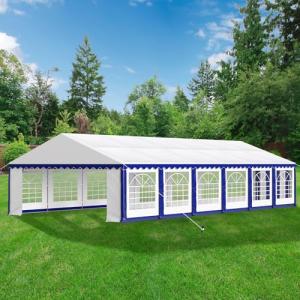
The tent comes with a full set of sidewalls that can be attached or removed depending on conditions and preference. The typical configuration includes two sidewalls fitted with lattice-accented windows (often using PVC or polyethylene panels to allow natural light transmission) and two sidewalls designed as zippered door panels for entry and exit. This four-sided setup gives you the option to fully enclose the tent for cold evenings, rainy afternoons, or events where privacy or wind protection is a priority.
When the weather cooperates and you want the openness of an outdoor event without sacrificing the overhead coverage, the sidewalls come down entirely, transforming the tent into an elegant open-air pavilion. The transition takes minutes and requires no tools — the walls attach via heavy-duty Velcro straps and bungee cord systems that hold securely but release easily.
The window panels serve a specific function beyond aesthetics. Solid sidewalls with no openings can create a stuffy, enclosed atmosphere, particularly in summer heat. Windows allow cross-ventilation while maintaining weather protection, giving guests the airflow of an outdoor setting without direct exposure to wind or rain. The 160g PVC used for window panels in this category is durable enough to withstand repeated folding and unfolding without cracking or yellowing — a common failure point in cheaper alternatives.
Anchoring and Stability: Getting It Right
A tent that isn't properly anchored is a tent waiting for the wind to decide its fate. The ActiveTrail comes with the hardware needed for both grass and hard-surface installations.
For lawn and backyard setups, ground stakes drive into the soil at each corner and along the guy rope attachment points, creating a multi-point anchor system that distributes load across the entire perimeter. The tent also ships with corner ropes (guy lines) that extend outward from the base, dramatically improving wind resistance by creating tension anchors at low angles to the ground.
For patios, concrete driveways, or other hard surfaces where traditional ground stakes won't work, expansion screw anchors provide a concrete-compatible alternative. These require pre-drilling but create a secure hold in surfaces that would otherwise leave the tent vulnerable to uplift.
The practical advice that experienced event planners will tell you: never underestimate the anchoring step. A tent that looks sturdy in still air can become a dangerous projectile in a sudden gust. Take the time to stake every point, tension every guy rope, and if you're setting up on an open property without natural windbreaks, consider adding sandbags to the base legs as supplemental ballast.
Setup: What to Expect on Assembly Day
A 20x20-foot tent is not a one-person job. Be honest with yourself about this before you invite two guests to "help for a few minutes" and spend the next three hours wrestling with a steel frame.
The recommended crew for a tent of this size is four to six people. The assembly sequence generally involves: laying out and identifying all frame components, assembling the main frame structure starting from the corner legs, connecting the ridge poles and interior cross-supports, draping and securing the canopy roof over the assembled frame, attaching the sidewalls as desired, and completing all staking and anchoring work.
A full team that's done it once before can complete the process in 90 minutes to two hours. First-timers should plan for three hours minimum and set aside the frustration budget accordingly.
The tent typically ships in two or three separate packages. They may not arrive simultaneously, so check all delivery confirmations and make sure every box has arrived before you begin assembly — particularly before your event deadline.
Storage between uses is aided by the included Oxford fabric storage bags, which keep the folded panels and frame components organized and protected during the off-season. Proper storage dramatically extends the life of the fabric; folding the canopy when it's dry and storing it away from direct sunlight prevents the mold and UV degradation that shortens the life of lesser tents.
Ideal Use Cases: Where This Tent Performs Best
The ActiveTrail's 400-square-foot footprint and commercial-grade construction make it genuinely versatile, but it earns its keep most reliably in a specific set of contexts.
Wedding Receptions and Ceremonies: This is where the tent's white elegance and full enclosure capability shine. The clean aesthetic pairs naturally with wedding décor, and the ability to close all sidewalls for an evening event while maintaining overhead coverage is exactly what a reception needs. String lights and draped fabric transform the interior into something genuinely beautiful.
Graduation Parties: A backyard grad party for 40 guests under a proper tent rather than a cluster of small pop-ups is a qualitative upgrade in every respect. Guests can move freely, catering tables have dedicated space, and the whole affair feels intentional rather than improvised.
Backyard Festivals and Seasonal Events: Fourth of July cookouts, Oktoberfest parties, holiday gatherings — events that recur annually are exactly the use case that justifies the investment in a durable, reusable shelter. Buy it once, store it well, use it for a decade.
Corporate and Commercial Events: The "commercial shelter" designation in the product description isn't marketing fluff. This tent is appropriate for vendor booths, outdoor pop-up markets, company picnics, and brand activations where professional appearance matters and weather protection is essential.
Farmers Markets and Craft Fairs: Event vendors who need a large, branded footprint at outdoor markets will find the 20x20 setup gives them enough space for display tables, product storage, and customer browsing without the cramped feeling of smaller canopies.
Comparison Table: How the ActiveTrail Stacks Up Against the Competition
When spending several hundred dollars on an event shelter, it pays to understand what alternatives exist at similar price points and what trade-offs each involves.
| Feature | ActiveTrail 20x20 | Quictent 20x20 | DWVO 20x20 | YITAHOME 20x20 | Outsunny 20x20 |
|---|---|---|---|---|---|
| Footprint | 20 x 20 ft (400 sq ft) | 20 x 20 ft (400 sq ft) | 20 x 20 ft (400 sq ft) | 20 x 20 ft (400 sq ft) | 20 x 20 ft (400 sq ft) |
| Frame Material | Galvanized Steel | Iron Metal Frame | Galvanized Steel | Galvanized Steel | Steel |
| Pole Diameter | 1.5" (38mm) | 1.5" (38mm) 1.2mm thick | 1.5" (38mm) | 1.5" (38mm) | 1.5" (38mm) |
| Roof Fabric Weight | 160g PE | 160g PE | 140g PE | 140g PE | PE Fabric |
| Waterproof Roof | ✅ Hot-sealed | ✅ Hot-sealed | ✅ | ✅ | ✅ |
| UV Protection | ✅ 99% UV Block | ✅ | ✅ 99% UV Block | ✅ 99% UV Block | ✅ |
| Removable Sidewalls | ✅ | ✅ | ✅ | ✅ | ✅ |
| Window Sidewalls | ✅ Lattice-accented | ✅ Mesh + PVC | ✅ PVC windows | ✅ PVC windows | ✅ |
| Zippered Doors | ✅ 2 doors | ✅ 2 doors | ✅ 2 doors | ✅ 2 doors | ✅ 2 doors |
| Ground Stakes Included | ✅ | ✅ | ✅ (+ sandbags) | ✅ | ✅ |
| Storage Bags Included | ✅ | ✅ 3 bags | ✅ 2 Oxford bags | ✅ 2 bags | Not specified |
| Approx. Capacity | 30–40 seated | 30–40 seated | 30–40 seated | 30–40 seated | 30–40 seated |
| Color | White | White | White | White | White |
| Commercial-Grade | ✅ | ✅ | ✅ | ✅ | ✅ |
| Assembly Required | Yes (4–6 people) | Yes (4–6 people) | Yes (4–6 people) | Yes (4–6 people) | Yes (4–6 people) |
Decorating and Personalizing Your Tent
One of the underappreciated aspects of a clean white commercial tent is how receptive it is to decoration. The white fabric acts as a neutral backdrop that works with almost any color palette or aesthetic direction.
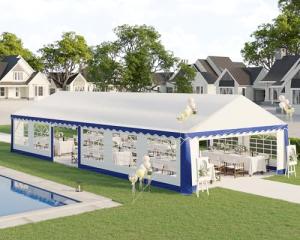
For a wedding, draping sheer white or ivory fabric from the peak creates a romantic, curtained effect that transforms the space from a functional shelter into something that looks genuinely designed. Adding bistro or Edison bulb string lights along the interior roofline provides warm evening ambience that photographs exceptionally well.
For a backyard festival or birthday party, colored bunting strung between the corner posts, balloon clusters at the entrances, and tablecloths in your event's color palette are fast, inexpensive ways to give the space personality. The tent's neutral white never competes.
For commercial and corporate events, a branded backdrop panel on one sidewall, accompanied by company-colored tablecloths and signage, creates a polished, professional appearance appropriate for customer-facing settings.
The one practical caution worth noting: this tent's fabric is not fireproof. That means open flames — candles, gas heaters, grills — should be kept well clear of the fabric perimeter. For evening warmth, electric patio heaters placed safely inside the footprint are a better choice than anything with an open flame.
Longevity and Maintenance: Getting the Most From Your Investment
A well-maintained 20x20 tent should last five to ten years with regular use. The factors that most determine longevity are how the tent is stored, how it's handled during setup and breakdown, and whether it's dried properly before being packed away.
Moisture is the primary enemy. Folding and storing a tent that's still wet — even slightly damp — creates conditions for mold and mildew growth inside the packed fabric. These organisms degrade the material from within and can create permanent staining and structural weakening over time. After each use, allow the canopy and sidewalls to dry completely before packing them into the storage bags. If an unexpected rain forces you to pack up wet, unpack and air out the tent at the earliest opportunity.
The frame components should be inspected periodically for developing corrosion, particularly at the joint connectors. Galvanized steel is resistant but not immune — any areas where the zinc coating has been scratched or abraded become potential rust initiation points. Light surface rust can be treated and stopped; left unattended, it compromises the structural integrity of the joint.
The Velcro and bungee connection points on the sidewalls should be checked for wear before each event. These are the highest-repetition components on the tent — attached and removed potentially dozens of times over the tent's life — and replacing a worn bungee hook costs pennies compared to the frustration of a sidewall that won't stay attached during a reception dinner.
Is the ActiveTrail 20x20 Right for You?
The honest answer depends on how you plan to use it and how often.
If you're hosting one event every few years and mainly need overhead coverage for a modest gathering, a simpler, smaller, or less expensive option might serve you adequately. The 20x20 is a substantial tent that demands proper setup effort, appropriate storage space, and a genuine event footprint to justify it.
But if you host events regularly — summer parties, annual gatherings, recurring community or commercial functions — the investment calculus changes entirely. Event tent rental for a 20x20 structure typically runs $300 to $600 per day depending on the market. A tent of this quality, purchased outright and maintained well, pays for itself after two or three rentals' worth of events. That math becomes more compelling every year you use it.
The ActiveTrail 20x20 ft Heavy Duty Party Tent occupies the sweet spot between consumer-grade weekend canopies and full professional event infrastructure. It's engineered with commercial intent — galvanized steel frame, hot-sealed waterproof roof, full enclosure capability — but designed for the reality of the ambitious home host, small event planner, or outdoor vendor who needs a reliable, beautiful shelter that they can set up, break down, and store on their own terms.
When the forecast gets uncertain and the guest list gets long, this is the kind of tent that makes you glad you planned ahead.
Disclosure: This article contains affiliate links. Purchases made through these links may earn a commission at no additional cost to you.